Friday, 5 September 2008

Backup Strategies for your Ham Station

We all do backups, right? I've been guilty of not backing up enough. Our valuable information, logs, programs, browser favourites, all manner of configurations, photos and all the valuable material we sometimes take for granted. We never expect a crash or hard drive failure. My stint in the IT field left me with some lasting impressions of poor practices when it comes to backing up software. Redundancy is key here. A poor practice is having your backups only in one place, like the hamshack or a file cabinet somewhere in the home. Even having a copy of your backups at the office makes it difficult to restore a system or files in the event your only backup is there.

My backup strategies are pretty simple but effective. Invest in a large USB thumb drive - one can fit an enormous amount of information on these little devices - your complete log book and browser favourites and lots of other stuff. Use a file compression program and you can fit even more info on these thumb drives. Buy good quality CDs or DVDs and religiously backup to 'glass'. Software is available that you set and forget - it will automatically backup to your DVD drive at a pre-determined time. CDs and DVDs are cheap enough to change once a week or more. I always make a copy of my backup and spirit it away to another location. External USB hard disks are still vulnerable to crashing and offer no real backup solution unless that infomation is backed up to other media or off premises.

This brings me to a real neat piece of software that does remote backups. It uses the internet to send an encrypted backup of your files to a location based in the U.S. It's called MozyHome Remote Backup. I use the 'free' version and find that it's enough to backup my station logs, blog articles, browser favourites and just about anything else. It first does a complete backup of the files you choose then every day at your pre-determined time it will do a backup of only the changed files so backup times are very short. It does it all in the background and keeps a running log of any errors and successful backups. Mozy is a set-it-and-forget-it designed backup solution. I highly recommend it for any ham station setup. You can add multiple computers to the same account. The free version allows 2GB of storage and works with Windows or Mac. MozyHome website

Many of us have more than one computer and our browser of choice happens to be Firefox. This browser is ultimately configurable with add-ons. One add-on that syncs bookmarks on multiple computers is Foxmarks. My laptop, main ham computer and another work computer all get seamessly synced up whenever I add a bookmark on any of the computers. All 3 systems have the same bookmarks. One can also configure so the home bookmarks don't get transferred to the work computer. You configure it the way you want it. If any of my browsers or computers have a good crash and I do loose all bookmarks and browser configurations I just add Foxmarks on the new installation of Firefox, (or IE ) type in my password and wait for the bookmarks to sync up. Couldn't be easier; and it's free, and it works. Highly recommended and now available for IE. Read more at the Foxmarks website.

Setting your radio for weak signal work

At VE3MPG digital modes are the preferred operating mode. I use low power and stealth type antennas and have been using PSK modes since I acquired my FT-100 in 2000. I ran across a really great article written by Larry, W7IUV, where he explains how to set up a FT2000 (or the FT-950 or any rig for that matter) for weak signal work and I'll quote some of his superb information below:


One of the biggest problems I see is that most people either don't know how to set up a radio for weak signal or they do and refuse to do it due to some personal agenda. Here's the way to hear weak signals either SSB, or CW;

Listen to the background noise. Does it move the S-meter at all? If yes you have the radio set up wrong. Yaesu provided a switch to select preamps or not and another switch to select input attenuation. USE THEM! On the low bands (160-30 meters) I will almost never operate with one of the preamps on. IPO ON all the time. Look at the S-meter. If it wiggles at all with background noise, add attenuation until it stops wiggling. On all modern radios there is about a 20-30dB difference between MDS and where the AGC starts working. You want the background noise (QRN, power line, QRM, whatever) to be at a level just below the point where the AGC starts working. That's also the point where the S-meter starts wiggling! At this level, when you tune across a weak signal it will jump up out of the noise at you. Note that setting the radio this way will NOT impair your ability to hear the weakest signal possible with current band conditions. The S-meter does not tell you S/N, stop trying to make it read upscale all the time!

Use the narrowest filter possible. Wide for me is 300 Hz. That's what I use for trolling the band. When things get tuff, I switch down as far as possible. Learn to use the narrow filters, they work far far better than screwing around with the shift and notch and other do-dads.

Do not use the RF gain control. If you have a SX-100 or a HQ-180 or maybe a R-390A it's a good thing. With modern radios like the FT-2000, using the IPO and ATT is far more effective. Also, depending on how and where the AGC voltage is applied to the RF and IF stages, using the RF gain control could possibly reduce your IMD performance and reduce you ability to hear weak signals due to increasing the noise figure faster than reducing the gain.
I've tried Larry's methods and on my 'old' FT100 it works great. On the FT-950 it works even better. I can copy weak psk signals better and it gets rid of much of the background noise. The signal traces on digital modes become very distinct using this method.

More info on Larry:

Larry - W7IUV
http://w7iuv.com/

Thursday, 4 September 2008

Young DXpeditioners Wanted!

Hey, I'm still young, I'm a ham, can copy some CW, but don't even fit the upper end of their age criteria. Youth is wasted on the young. Read on -

The crew of VK9DWX wants to invite two young hams who have a passion for Ham Radio, DXing and contesting to take part in the DXpedition to Willis Island in October this year.

One young ham from 6th October till 19th October and the other one from 15th October till 28th October.

You can reside in any country in the world, you hold a valid amateur radio license in your country, you have some experience in working pile-ups and you are between 18 and 29.

For qualification you have to send an email to contact @ vk9dwx.de which must include an essay of 500 words minimum (in English) describing how you got started in ham radio, who your Elmer was and why you should be selected for this DXpedition opportunity. Please include also you full name, callsign and home address.

The VK9DWX crew will pay for all expenses except your flight from your home to Cairns, Queensland, Australia. (VK9DWX)

Send us your application now to contact @ vk9dwx.de. We will receive applications until September 15th and will make a fast decision.
Are there any readers that meet the criteria??

Willis Island is an island in an external territory of Australia, located beyond the Great Barrier Reef in the Coral Sea some 420 km east of Cairns, Queensland. It is the southernmost of a group of three islands, which with their associated sandy cays stretch in a NNE to SSW line for about 12 km. Willis Island itself is aligned NW to SE and is about 500 m long by 150 m wide, 7.7 ha in area, rising to just under 10 m above sea level. It is the only permanently inhabited island in Australia's Coral Sea Islands Territory. (Wikipedia)

VE8RCS/VY0 and Alert, Ellesmere Island

We've been hearing them and some of us have worked VE8RCS/VY0 and no doubt they are causing some good pile ups on the amateur bands where they show up. A couple of nights ago they were on the low end of 40 meter CW (7.009MHz). They sat there for a little over four hours pounding out the contacts. Check out Scott Crouse's special CFS Alert web site for up to the minute news and some great photography from this DXpedition.

Ellesmere Island is part of the North American IOTA Group. The designation for Ellesmere is NA-008 for the information exchange during a contact with VE8RCS/VY0. This is a rare one no doubt. Here's a map showing Ellesmere Island and the surrounding area including part of Greenland and Thule air base.

Ellesmere Island is the largest island of the Queen Elizabeth Islands located off the northwest coast of Greenland. The island is about 500 km wide and 800 km long and has an area of about 200,000 sq km. It is the most rugged in the Canadian Arctic Archipelago. Cape Columbia, at latitude 83ยบ07' N, is the most northerly point of Canada, and Barbeau Peak, at an elevation of 2,616 metres, is the highest point in Nunavut. The settlements are all quite small, including Eureka, Grise Ford (Aujuittuq), and Alert. Alert is the northernmost community in North America.

Alert is an unforgiving place where night and day dominate the seasons. From late March till the middle of September there is 24-hour daylight. And from the middle of October until the end of February, the sun does not make an appearance, culminating in 24-hour darkness. To make matters worse, temperatures rarely move above the freezing level. And in an emergency situation, help may not come very quickly, as only two ships have ever reached CFS Alert!
(Ellesmere Island website)


Wednesday, 3 September 2008

Countries I've operated from

Licensed since 1980 I've had the opportunity to operate in Britain, the U.S., and Slovakia during the remnants of the Velvet Revolution. The Soviet army was still firmly entrenched in many parts of Slovakia and Czechoslovakia at that time. I was granted a license by the new government and also permission to set up a packet station at the university residence where my humble room was located. With the help of several students who were amateurs a packet station was installed. I was using a very basic laptop that booted DOS 3.3 from disk - a Radio Shack, dual 720Kb disk drives and a black and white LCD screen. With this modest station I connected into Budapest and from there to the rest of western Europe. It was a great time to experience democracy being embraced with open arms. I will have to find my Slovak radio license for those years. The first photo shows me inside a Soviet camp with three young Russian soldiers. Their camps were very run down and through my translator, they told me that they didn't know what they were still doing in Slovakia. This camp was on the border of Slovakia and Hungary in a village called Roznava. This was the summer of 1990.

Summer Storms in FN25fe


We've had strange weather conditions for most of this summer season. These disturbances were accompanied by extremely strange cloud formations. The national and local weather gurus attribute this bizarre weather to the jet stream being further south than it's supposed to be. Out here near Metcalfe I can see the storms approaching from a good distance. I've attached a few photos of these foreboding formations. Heavy or light rain showers ensued along with some extreme temperature drops. Didn't see any hail this year.


The radios get unplugged and disconnected, from the AC mains, antennas and grounds. My Buddistick gets lowered to its low profile setting and the anchors get an extra brick or two. More on this in a later post.

OARC, MARG, Summer 2008

Well it certainly has been awhile since my last post. I have no excuse. Amateur radio is now more important than ever to me since my cochlear implant in October of 2006. I've acquired some new HF gear but still lean heavily to the digital modes. SSB is still very difficult to understand. Some have good audio, and some, really bad audio, along with poor diction techniques over HF SSB and other bands and modes.


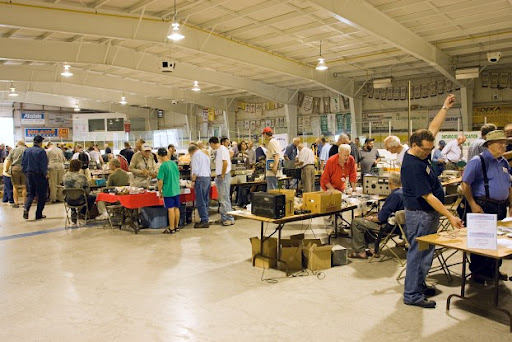
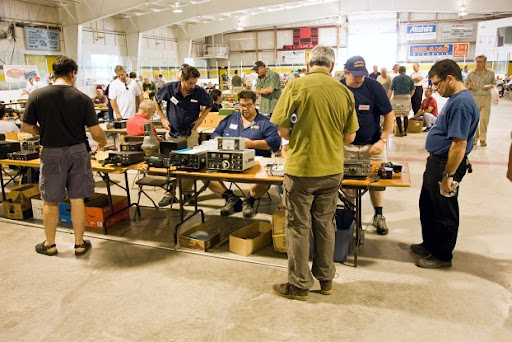
Last Saturday the Ottawa Amateur Radio Club hosted its latest flea market at the Carp Fair grounds in Carp Ontario. Hundreds of area hams and many from outside the region helped make the flea market a huge success for the OARC.


The Manotick Amateur Radio Group attended in full force and had a table full of gear for sale or trade. Mike, VA3MPM presided over a good chunk of the treasures at this table as well as Darrell VA3RDC, Brian VA3DXV, and Norm VE3NLH.