Showing posts with label psk. Show all posts

Tuesday, 30 March 2010

QRP DX

Operating QRP these last few days has been fun and a challenge. I can work lots of DX with 5 watts from my FT-817. Most stations don’t know I’m running 5 watts until my brag macro informs them. I run digital modes 100% here. The challenge is that many stations run excessive power; some run dirty signal that wipe out the psk segment of the bands I’m working on. Here’s a screen shot of a Cuban station with sidelobes so strong the band segment was wiped out up here in Ottawa. Setting up your station for proper operation using digital modes takes some effort. Excessive power into yagi, verticals or dipole antennas isn’t necessary; it’s important to monitor ALC (assure that the ALC setting of your S-meter shows no movement) when ones changes band and even moving within the passband where you’re operating. Proper adjustment and judicious use of RF output makes it a whole lot easier for everyone using the narrow psk segments of our shortwave bands. signal sidelobes Of course the little FT-817 doesn’t play as nice as the Ft-950 – I have no filters installed and there are no DSP controls to make things easier on digital modes.

Working QRP is a challenge; I usually wait until a station signs off with another station and then I call them and usually that gets me the DX. When you’re working with 5 watts you want to make sure all of your power gets out to the antenna. That means no antenna tuners. Make your antenna resonant for the band you’re working. 99% of the DX stations I’ve been working give an honest 599 report with a few 569 reports so my setup is doing something right. I always make use of an antenna analyzer to check my antenna a few times a month to make sure all is working as it should.

Here are a few stations worked from my QTH in south Greely – FN25fe – F5FMO, PA3HDG, RA3FO, G0UAN, ES4MM, 2E0GHQ, SM0EJR and RA6AN. Some of these stations are well over 7,000Kms away yet with 5 watts most gave consistent 569 - 599 reports– there was the odd dropped character due to fading and interference from strong stations but the DX is out there – you don’t need a lot of power and it’s fun once the other QRO station finds out you’re only running 5 watts to a vertical antenna. I’m able to work both strong and weak stations – it doesn’t seem to matter too much.

FT817 on dash I have plans to order a CW filter to install in the FT-817 to make things a bit easier. I also plan to do some portable operating like I did almost ten years ago when I first got the 817. I used Hamsticks in those days with a large magnetic mount. Hamsticks work very well when conditions a good but they did get the job done during Cycle 23.2001 Corolla with 17m Hamstick

QRP Blogs and Websites via K4UPG.com

QRP Amateur Radio Club International

Sunday, 21 February 2010

Yaesu FT-950 – Solid Performer With PAR End Fedz

%5BUNSET%5D[1]

After over two years of owning the FT-950 it’s still a solid performer. In the field, during Field Day 2008 with auxiliary power and a PAR EF-40 End Fed along with a Buddipole it was exemplary. At home in the shack it’s even more fun. The menu system offers lots of settings for personal preferences and I often change parameters if I see something on the Yahoo FT-950 group that I find interesting. I keep copious notes in a small notebook of all the settings I’ve ever tried, with dates and comments. The primary use of the 950 is on psk and cw modes; I rarely run more than 30 watts to my antennas which include the Cushcraft R6000, and several PAR End Fedz dipoles. The PAR antennas have survived two brutal winters with ice storms. The last ice storm a few weeks ago saw the PAR antennas coated with almost 2 centimeters of ice but they held up very well. The EF-40 is over 20meters (66 feet) in length so that’s a lot of ice load to carry. We also get terrific winds out here but the PARs just keep going – a testament to their engineering and design. I have plans to erect a full G5RV and an end fed loop this year on my 2 acre property south of Ottawa. I would like to get back on 160 meters in time for next winter.

Since the release of the FT-950 in the fall of 2007 Yaesu in Japan has released firmware updates – numerous updates called the PEP950-Performance Enhancement Program with updates available for download on the Yaesu website. Each update added features and improved functions – with feedback garnered from the user community and Yaesu’s monitoring of the FT-950 group on Yahoo. Dennis Motschenbacher K7BV, (Yaesu VP of Sales) often drops by the group with information and comments. Dennis was even kind enough to send me a poster of the new Yaesu 5000 transceiver including the Yaesu world map. It’s really great to see a company interacting with users and potential users in this way.

In 2010 it’s hoped that Yaesu will continue to improve and update the firmware in the FT-950. With the release of the new FT-5000 Yaesu will continue to be at the forefront of cutting edge communications gear.

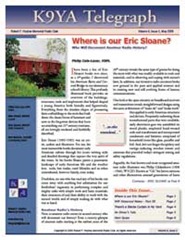
Cover_K9YA Telegraph MAY 2009 Some of you may be aware of free amateur radio publications such as WorldRadio online magazine available for download. There’s another publication free of charge from the Robert F. Heytow Memorial Radio Club called the KY9A Telegraph. It’s by subscription so an email notification is generated and sent to you when a new issue is ready for donwload. Both of these publications are in the Adobe PDF format. Highly recommended reading during these long winter nights.


Interview with Dale Parfitt – PAR Electronics

Friday, 5 September 2008

Setting your radio for weak signal work

At VE3MPG digital modes are the preferred operating mode. I use low power and stealth type antennas and have been using PSK modes since I acquired my FT-100 in 2000. I ran across a really great article written by Larry, W7IUV, where he explains how to set up a FT2000 (or the FT-950 or any rig for that matter) for weak signal work and I'll quote some of his superb information below:


One of the biggest problems I see is that most people either don't know how to set up a radio for weak signal or they do and refuse to do it due to some personal agenda. Here's the way to hear weak signals either SSB, or CW;

Listen to the background noise. Does it move the S-meter at all? If yes you have the radio set up wrong. Yaesu provided a switch to select preamps or not and another switch to select input attenuation. USE THEM! On the low bands (160-30 meters) I will almost never operate with one of the preamps on. IPO ON all the time. Look at the S-meter. If it wiggles at all with background noise, add attenuation until it stops wiggling. On all modern radios there is about a 20-30dB difference between MDS and where the AGC starts working. You want the background noise (QRN, power line, QRM, whatever) to be at a level just below the point where the AGC starts working. That's also the point where the S-meter starts wiggling! At this level, when you tune across a weak signal it will jump up out of the noise at you. Note that setting the radio this way will NOT impair your ability to hear the weakest signal possible with current band conditions. The S-meter does not tell you S/N, stop trying to make it read upscale all the time!

Use the narrowest filter possible. Wide for me is 300 Hz. That's what I use for trolling the band. When things get tuff, I switch down as far as possible. Learn to use the narrow filters, they work far far better than screwing around with the shift and notch and other do-dads.

Do not use the RF gain control. If you have a SX-100 or a HQ-180 or maybe a R-390A it's a good thing. With modern radios like the FT-2000, using the IPO and ATT is far more effective. Also, depending on how and where the AGC voltage is applied to the RF and IF stages, using the RF gain control could possibly reduce your IMD performance and reduce you ability to hear weak signals due to increasing the noise figure faster than reducing the gain.
I've tried Larry's methods and on my 'old' FT100 it works great. On the FT-950 it works even better. I can copy weak psk signals better and it gets rid of much of the background noise. The signal traces on digital modes become very distinct using this method.

More info on Larry:

Larry - W7IUV
http://w7iuv.com/