Showing posts with label PSK31. Show all posts

Wednesday, 24 October 2012

Band Conditions and DX

My apologies for not posting of late. Just too much going on but I do manage to get down to the shack late in the evenings. This has always been my favourite time to hunt DX. I’m a casual DXer and I don’t do contests. My work schedule allows for late nights and early morning operating times. I follow Hamspots.net, and operate digital and JT65-HF exclusively. I keep power levels below 20 watts and 99% of the time keep it at 10 watts out using my FT-950. I’ve done this even during the lowest parts of the 11 year sun cycle and still managed to work lots of rare and obscure stations. Often when the band seemed dead, out pops a rare South Pacific station and I snag them on the first call.

IMG_1580Just yesterday I worked Tanzania, 5H3NP, Noel, at 0400Z on 20m psk31 running all of 15 watts. Noel had a good clear signal and he told me he’s on every night at the same time. I did hear him the previous evening but he was working Europeans and Russian stations in a pile up.


d2qrA couple of days ago, on 10 meters Serg, D2QR was on from Angola; again a nice strong signal and worked him on his first CQ call. The call looked familiar and checked my log and sure enough I had worked Serg in 2004 on 20 meters.

Earlier at 0445Z I worked Metin in Istanbul Turkey on 20m psk31. I noticed that I worked the Turkish and Tanzanian just after their sunrise times. I monitor this by reception reports displayed by PSKReporter maps and can watch the grey line creep along the countries that I’ve just worked. It’s a great DXer’s tool. It’s integrated into the current version of Digital Master 780.

Conditions have been really very good lately and urge you to get on the bands and work some of the rarer low power stations currently easy pickings during the late night hours on 20 meters and daytime DX on the busy 10 meter band.

Thursday, 27 September 2012

10 Meters = Gud DX

10 meters is proving to be a fertile band for some good DX. I rarely use more than 20 watts here at VE3MPG. My preferred mode is digital; today I was monitoring 10 meters while getting some odd jobs done around the house and in the garage.

The great conditions on 10 remind me when I finally got my voice privileges way back in the early 1980s. After six months or a year, I can’t accurately remember I took my logs in to the Department of Communication here in Ottawa. The inspector had a look to see how active I had been on CW and stamped my log and gave me voice privileges on 160 and 10 meters. Ten in those days was very active and I installed a mono-band yagi on my roof up about 40 feet. Wall to wall signals and my TS-520 buzzed the ionosphere for many pleasurable hours working DX.

Back to today – my first contact was ZB3R in Gibraltar. I had worked Stephen a couple of weeks ago on 15 meters. Great signal and got him on the first call – power out about 15 watts to my Cushcraft R6000.zb3r_StephenStephen uses an FT-950 and you can see how professional his station looks. Have a look at his QRZ profile for more pictures of Gibraltar itself and more about Stephen’s station.

The second DX contact today was ZL4AD, Brian in New Zealand; again with 15 watts out and an honest 599 report from Brian. I’m using the latest Beta version of Ham Radio Deluxe for digital contacts and logging.

Now if the conditions continue into the weekend that would be great.

Friday, 31 August 2012

Take A Cool Stand

NUE-PSK modem stand1

A few months ago I happened to be at one of the local Dollar Stores. They do have some interesting end of line and overstock items for sale especially in their electrical and electronic aisles.

I have a NUE-PSK modem and compact keyboard combo for QRP portable ops with my trusty FT-817. It was always a pain propping the NUE-PSK modem at the correct angle for viewing the LCD screen until I found this iPad stand for the sum of $2CDN. It was a perfect fit for the modem and I could adjust the angle for best viewing.

I’ve seen these for sale on the internet for well over $20CDN so the Dollarama price is a steal. The stand is very well made – rubber coated steel so it is slip resistant and the locking knobs to a decent job of staying in position once locked. It’s a useful stand and can be used with a variety of QRP radios making it easy to see and adjust the various knobs from a comfortable angle.

© Bob Baillargeon-3249


© Bob Baillargeon-3255

© Bob Baillargeon-3258

© Bob Baillargeon-3262

You can see the detail close up to the right. Works great and I’ve got a couple of extra for future projects.

The NUE-PSK modem has been great for portable QRP operation. It is field upgradeable via a USB port and can be used in BPSK (PSK-31), QPSK, RTTY and CW. There are regular upgrades of new features and bug fixes from the NUE-PSK Digital modem website.

The modem and keyboard are powered from either and external 9V – 12V supply. A USB dongle is able to log call signs and QSOs so they can be transcribed to regular logs. The new Version 5 firmware adds a CW keyer to the modem. All in all it’s a nice portable package and frees you from lugging a heavy laptop to do digital modes in the field.

Friday, 9 July 2010

Late Night DX On 20 Meters

It’s out there. Last night saw me re-connect with Bill, ZL3NB in Christchurch New Zealand at 0437Z. His signal was 599 and his report to me was the same. There was some QSB but armchair copy using Ham Radio Deluxe and PSK31. My output was set to 25 watts and again this was using my Cushcraft R6000. That’s a distance of 8835 Kms or 14218 miles. Not bad for a low power digital QSO.

ZL3NB_Bill

I had originally worked Bill in April of 2004 and I happened to be one of his first digital contacts at around the same time at 0358Z six years ago. It was nice re-connecting with Bill. He worked a couple of more stations after my QSO and then called CQ for a long time. It was time for bed knowing there was lots of DX floating around despite the low sunspot numbers.


ZL3NB_Station

Bill’s ham shack in New Zealand. The main equipment consists of a Kenwood TS2000 and TS530S (Classic setup with the VFO240 and SP230) along with a Ameritron Amp. Antennas consist of a Mosley TA33 tribander and inverted vee's for 80/40 and 30 meters.

I suspect there’s more DX at that time of the morning, rolling in from the South Pacific area – I just ran out of steam and had to pull the plug.

The steamy heat wave enveloping Ottawa finally broke early this afternoon with some rainshowers and thunderstorms. Temperatures plummeted to +23C and power went out for a few short seconds. It’s time to leave antennas disconnected and grounded before these intense summer storms move into the area. It’s good practice and could save you a bundle if there’s ever a lightning strike close by.

For more info on Christchurch go to: www.christchurch.org.nz

Sunday, 2 May 2010

20 Meter DX – Band Wide Open At 04:15Z

ua0zay

It’s early morning (04:15Z) out here in the south of Ottawa. 20 meters is wide open and DX stations fill the digital portion of the band. Lots of Pacific stations and quite a few Asiatic Russian stations on the air this morning. Background noise is undetectable. I have the AGC in the FT-950 in the OFF position to better hear the weak stations on PSK. I’ve just worked UA0ZAY  Igor, on the Kamchatka Peninsula. I hear Hawaii calling CQ with mostly stateside stations responding. I’m on the Cushcraft R6000 this morning running about 30 watts.

Earlier I had worked UA0ZK, Vasily, also on Kamchatka. Signals were all 599 and perfect copy. If you’re a night hawk there’s DX to be had with very little effort.

ua0zk

Petropavlosk Kamchatsky harbour_sm

The Volcanoes of Kamchatka are a UNESCO World Heritage Site. Photo courtesy of Wikipedia.

Tuesday, 30 March 2010

QRP DX

Operating QRP these last few days has been fun and a challenge. I can work lots of DX with 5 watts from my FT-817. Most stations don’t know I’m running 5 watts until my brag macro informs them. I run digital modes 100% here. The challenge is that many stations run excessive power; some run dirty signal that wipe out the psk segment of the bands I’m working on. Here’s a screen shot of a Cuban station with sidelobes so strong the band segment was wiped out up here in Ottawa. Setting up your station for proper operation using digital modes takes some effort. Excessive power into yagi, verticals or dipole antennas isn’t necessary; it’s important to monitor ALC (assure that the ALC setting of your S-meter shows no movement) when ones changes band and even moving within the passband where you’re operating. Proper adjustment and judicious use of RF output makes it a whole lot easier for everyone using the narrow psk segments of our shortwave bands. signal sidelobes Of course the little FT-817 doesn’t play as nice as the Ft-950 – I have no filters installed and there are no DSP controls to make things easier on digital modes.

Working QRP is a challenge; I usually wait until a station signs off with another station and then I call them and usually that gets me the DX. When you’re working with 5 watts you want to make sure all of your power gets out to the antenna. That means no antenna tuners. Make your antenna resonant for the band you’re working. 99% of the DX stations I’ve been working give an honest 599 report with a few 569 reports so my setup is doing something right. I always make use of an antenna analyzer to check my antenna a few times a month to make sure all is working as it should.

Here are a few stations worked from my QTH in south Greely – FN25fe – F5FMO, PA3HDG, RA3FO, G0UAN, ES4MM, 2E0GHQ, SM0EJR and RA6AN. Some of these stations are well over 7,000Kms away yet with 5 watts most gave consistent 569 - 599 reports– there was the odd dropped character due to fading and interference from strong stations but the DX is out there – you don’t need a lot of power and it’s fun once the other QRO station finds out you’re only running 5 watts to a vertical antenna. I’m able to work both strong and weak stations – it doesn’t seem to matter too much.

FT817 on dash I have plans to order a CW filter to install in the FT-817 to make things a bit easier. I also plan to do some portable operating like I did almost ten years ago when I first got the 817. I used Hamsticks in those days with a large magnetic mount. Hamsticks work very well when conditions a good but they did get the job done during Cycle 23.2001 Corolla with 17m Hamstick

QRP Blogs and Websites via K4UPG.com

QRP Amateur Radio Club International

Friday, 26 March 2010

QRP on 17 meters with the FT-817

In my previous post from late last evening I decided to get my 817 back on the air and attempt some qrp contacts. I was really surprised at what 5 watts into 130 feet of coax to a vertical can do. I’ve been working all over Europe and to the southern U.S. states with this barn burner. Most contacts took one call with the real DX taking 2 to 3 calls. There was lots of QSB and the band was wall to wall digital signals. Low power and high power stations and stations with sidelobes – lots of sidelobes.

Setting up the 817 took a bit of effort since there are no DSP filters like in the FT-950 – nada, nothing. I had to resort to the RF gain control and the RX control on the Signalink USB interface to dig the signals out. The 817 performed admirably. I had the 817 stored in an Eagle Creek pouch for protection and its little log book with the last entries dated in 2001.

FT817_Log_2001_smThe 817 was an early 2001 copy with no filters installed. Way back in 2001 I was still able to make SSB contacts (before I lost all of my hearing) and these QSOs (log book above) were made from my car with monoband Hustler verticals – not the most efficient antennas. They were cheap and they worked and allowed me to operate mobile from quiet locations. At that time I still lived in the downtown core of Ottawa – a very noisy environment, even before the days of plasma TVs. I traveled south to one of the locks on the Rideau Canal near Manotick and operated parked near the lockmaster’s building. As you can see from the log conditions during that Cycle 23 were very good.

Today’s contacts included IK7EJT, LB1TE, YL2JZ, DL5ZAA, IZ4BEZ, and KB0QC all on psk. I had a 569 report and all other sig reports were 599. Conditions are very good and the 20 meter band stays open quite late here in North America. 17 meters fades out at sunset.

QRP is lots of fun and a bit of a challenge for simple transceivers lacking all the new DSP controls of the new radios.

I hope to fill out my little log book with more contacts during this year’s upcoming Field Day. I will be operating with the Ottawa Valley QRP Society from Bate Island on the mighty Ottawa River.

For the record space conditions as follows:

Solar-terrestrial indices for 25 March follow. Solar flux 88 and mid-latitude A-index 5. The mid-latitude K-index at 1500 UTC on 26 March was 2 (12 nT). No space weather storms were observed for the past 24 hours. No space weather storms are expected for the next 24 hours.

SpaceWeather.com

The Firmament – Jan Timmermans

Tuesday, 24 March 2009

Antennas Survive Ottawa Winter

My antenna farm survived the brutal, windy, snowy, freezing rain type weather known in this neck of the woods. Some good planning, engineering and blind luck allowed my PAR EndFedz and my Cushcraft R6000 to survive unscathed through the arctic like conditions up here. A 3-point guy system protected my R6000 from self-destruction. The PAR EndFedz were securely anchored with enough slack to survive the windy conditions south of Ottawa. We do get some extreme winds out here. A couple of years ago, during a micro-burst type summer storm I lost some siding on the upper story of my home. Anything not anchored down gets blown to the next county.

DX has been hit and miss but throughout the season there's been some good conditions favourable for long haul communications. D44TXF on Cape Verde - 17m, NH6I Hawaii on 40 meters, ES3RM - Estonia on 17m, 5D0IPY - Morrocco on 17m, ZS6GAV - South Africa on 17m, and many more. The 17 meter band has been open during the very early morning hours during dawn and stays open for at least a couple of hours. Despite the low sunspot numbers there's a lot of DX to be had. I'm working these stations with a multi-band vertical and low power and on digital modes. Power reaching my R6000 vertical can't be more than 10-15 watts. I'm feeding it with 100 feet of RG59 75 ohm coax. At the transmit end I have my FT-950 set for 20 watts output.

The new Yaesu PEP FT-950 enhancements have made the FT-950 a superb DX rig. The receiver is quieter, the noise reduction settings now work great, and the AGC and Contour functions have been improved 100%. Check out the eham.net ratings for the FT-950 with the PEP enhancements. Satisfaction all around, and Yaesu is continuing to enhance the FT-9000, FT-2000 and FT-950 family of transceivers with regular firmware and DSP updates and features. The latest update to the FT-950 required a new operating manual to be released by Yaesu, such were the number of changes to the radio.

In conclusion the PAR EndFedz 40 and 30 meter antennas survived quite nicely through the rigours of an Ottawa winter, as did the recently refurbished Cushcraft R6000. Proper installation and guying were the key points that kept everything running with zero maintenance.

Wednesday, 4 February 2009

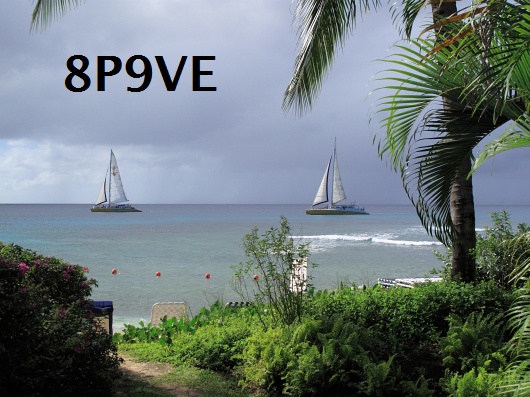
8P9VE Barbados Expedition


Ahhhhhh, warm, sunny, clear blue waters outside the door of a rented villa. Monday January 26th saw me leaving Ottawa (-29C) for a short holiday in beautiful friendly Barbados (28C). Ron, 8P6JB did all the paperwork and running around getting my license to operate in Barbados. I settled on the call 8P9VE as this represented a little of Canada in it.

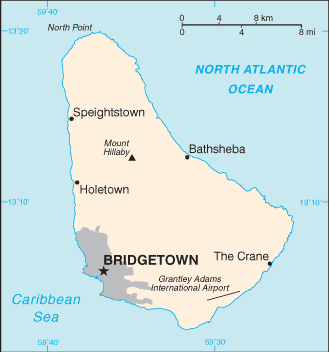
The villa was at Reeds House on the north west shore of Barbados. The back entrance and patio of the villa descended to a white sand beach and palm trees. Very much a heaven compared to icy frozen Canada. I traveled with my VX-170 and VX-3R handhelds and a small external window mounted antenna. I just happened to be in the shadow of the island repeaters so I couldn't qso with anyone from the villa unless I was in the rented van and up at a high point away from shore.

The Barbados Amateur Radio Society meets at their club station every Friday night for a social get together, and Ron 8P6JB invited me to attend. The club station is located at one of the highest points of land on the island just outside Bridgetown. It sits on a former sugar plantation and you can see the remnants of the old wind mill that powered the plantation machinery.


The Friday meetings are very informal and softdrinks and beer are available to all - which probably makes these meeting very popular. I got to operate the club station which is equipped with very modern up to date gear.

Peter, 8P9NX, a retired M.D. from the Mayo clinic in Minnesota was operating the station when I arrived. He quickly set up the club laptop for psk and I made a few stateside contacts on 40m psk that evening.

Peter's obsession is golf and ham radio since he retired to the island a few years ago. He plans to sail his 37 foot sailboat with his son, from the U.S. to Barbados later this year. Peter works about 50 stations a day on his K3 and CW - he does a bit of psk too.

Barbados currently has about 150 licensed ham radio operators. Barbados' population is 281,968 (July 2008 Est.). Peter was telling me that at these latitudes 80 meters and 160 meters are great in the evenings with very low noise levels. Getting a license to operate in Barbados cost $15USD and you have to send a copy of your Canadian license and a list of all the equipment you'll be bringing to the island. The license is good for one year and I plan to go back in a few months with my own equipment and a couple of my PAR EndFed antennas packed away in my suitcase. Using the 8P9 call created quite a stir on 40 meters but qrm was high due to the number of stations.


The club station also has emergency backup power via batteries and generators in case of natural or man made disasters. The stations included a Yaesu FT-1000 MkV, an FT-450, 2 meter handhelds and base radios along with older Kenwood and Icom radios - so a very well designed and equipped ham station. Antennas include wire dipoles, various beams and verticals.

I would like to thank again Ron Wilkinson 8P6JB for all of the legwork and keeping in contact with me while on Barbados and the great Friday evening club meeting of January 30, 2009. And a big thanks to Peter 8P9NX for showing me the ropes at the club station.

Geography
Area: 431 sq. km. (166 sq. mi.); 2.5 times the size of Washington, DC.
Cities: Capital--Bridgetown.
Terrain: Generally flat, hilly in the interior.
Climate: Tropical.


Saturday, 20 December 2008

3B8GT, Mauritius

Ham radio has been slow here at VE3MPG. I do get on most mornings just to listen around and I work PSK 99.99% of the time. It’s just a lot easier than trying to decipher SSB sigs with my less than perfect ear.

mauritius_map1 I was on this morning just before lunch and heard VE3JW, the amateur station over at the Museum of Science and Technology about 24 Kms to the north of me. Darin, VE3OIJ was just signing with a station, 3B8GT. Had to look that one up; and quickly, after Darin’s final, I got a call in to that DX station. He responded with a 599 and he was strong here too with some QSB. 3B8GT is the island of Mauritius about 900 kilometres to the east of Madagascar and east of Reunion Island in the Indian Ocean. A good catch indeed with all of 20 watts reaching my Cushcraft R6000 vertical. I’m not really sure how much signal reaches the antenna as I’m feeding it with 100 feet of RG59 el cheapo coax. That’s 75 ohm coax, but my FT-950 swr meter tells me there’s no reflected power. Let’s say that less than 20 watts gets radiated. The Museum uses a beam but I was hearing the Mauritius station Q5 here.3b8gt

The op on Mauritius is Alexey 3B8GT with a very modest station according to his QRZ.com listing – 50 watts to a 3 element yagi. Conditions seemed to be perfect this morning but looking at the solar terrestrial data indicated the solar flux at 69, A-index at 2 and the K-index at 0. Not so good propagation it says. Nevertheless the actual working conditions seemed excellent at the time. Local temperature was –17C, crisp and sunny. When I signed with Alexey I hung around a bit to see who might work him but he called CQ for a good ten minutes and no takers. My strategy is to look for weak traces on the waterfall and try to work those stations – usually they turn out to be some good DX. Last spring I worked Reunion Island late in the evening on 20 meters using this strategy – it took me a week to snag him due to pile ups he was generating. That contact was using a 20 meter hamstick and 20 watts.

Another PSK31 tip:
Use the center of your waterfall. Testing will show that your transmit (TX) and receive (RX) will be strongest there. Don’t blindly use 1000Hz tone or strictly follow the VFO ‘set it and forget it' concept. You can easily lose 20% or more of your power on each edge of your pass band. Pass band centering of the signal will give the best results of both RX and TX.

CIA World Fact Book on Mauritius

Wednesday, 12 November 2008

Cycle 24 Sunspot 1008


A new sunspot (1008) emerged this week signaling more Cycle 24 activity. The bands have been very good even up to 17 meters. PSK stations populate 18.100 and some good DX is to be had.


Above: New-cycle sunspot group 1007 emerges on Halloween and marches across the face of the sun over a four-day period in early November 2008. Credit: the Solar and Heliospheric Observatory (SOHO).

On Nov. 3rd and again on Nov. 4th, double-oh seven unleashed a series of B-class solar flares. Although B-flares are considered minor, the explosions made themselves felt on Earth. X-rays bathed the dayside of our planet and sent waves of ionization rippling through the atmosphere over Europe. Hams monitoring VLF radio beacons noticed strange "fades" and "surges" caused by the sudden ionospheric disturbances.

Good news for the upcoming winter season and should give us some decent conditions for working lots of DX.

I notice that an hour prior to sunset on 40 meters the Europeans start to roll in very nicely. Good signal strengths and many psk stations on. I work psk stations exclusively here and I'll write a future blog posting on that very soon. Well after dark 20 meters is still open with south American stations populating the band.

Coming up on November 22nd and 23rd is the "30 Meter Digital Group 1 Year Anniversary Weekend."

10.140  USB +/- 1000 PSK
(10.132 – 10.145 – HELL, OLIVIA, MFSK, RTTY, WSPR, PropNet, Etc)
 
10.140 +2000 – 30MDG Members Dedicated Hours from 1900z to 2200z
(30MDG members look for other members to ragchew with further up the waterfall)
 
Check into the 30 Meter Feld Hell Net:
30 Meter Net 0000 Z Monday 10.138. Feld Hell Net Control is W8LEW Lew.

Not sure what 30 Meters has to offer? Then go here:
http://www.30meterdigital.org/files/30_Meter_Band_INFORMATION.pdf

30 Meter Digital Group
 

Tuesday, 4 November 2008

FT-950 Back On The Air


It's been a few months since I've fired up the FT-950. Got it dusted off and moved back to the shack. The last time it was used was at the MARG Field Day at the Long Island Marina in Kars. It's hard to forget how great the receiver is in the 950.

Late this afternoon I worked TK5IH in Corsica and ZP8AE in Paraguay, on PSK, with 589 and 599 reports using 20 watts to the Cushcraft R6000. Earlier in the day using the 'old' FT-100, I worked Maria, SA2YLM on 20 meters. 17 meters opened just after lunch for a short time and managed to snag a few Europeans with great 5NN reports.

The nice 'width' feature of the FT-950 allows me to narrow down the passband and get rid of high powered stations close to the DX that I want to work. The HRD* waterfall below shows the passband with many signals.


The HRD* waterfall below shows no signals, on either side of the received psk track. This eliminates desensing of the receiver by narrowing the passband so strong signals on either side of the track being decoded dissapear. The FT-950 can also notch out a signal on either side of the decoded signal.


I use Ham Radio Deluxe as control software and Digital Master 780 for digital modes. I find it is one of the most intuitive ham software suites. It keeps track of my logs and can be used for just about any digital mode now current on the amateur bands. There's an excellent satellite tracking module included. Simon Brown, HB9DRV, is continually adding features and tweaking the software. The Ham Radio Deluxe forums are a repository of information pertaining to any subject about digital modes and how to connect Yaesu, Icom, Kenwood, and just about any transceiver to sound card interfaces and to your shack computer. HRD works with Windows XP and Windows Vista.

Some PSK tips:
In PSK modes use UPPER CASE characters sparingly. Lower case text in PSK31 varicode transmits fewer bits of data. You'll increase transmit speed and improve the likelihood of proper decoding on the other end by using lower case text as much as possible. (For example, the difference between a lowercase “e” (11) and an uppercase “E” (1110111) is three times more bits.)

*Ham Radio Deluxe

Monday, 3 November 2008

The R6000 Rocks!

Finally got the antenna connected late this afternoon and got on 20 meters, PSK. Worked Florida and Cuba with about 15 watts to the antenna. 599+ reports so I could lower the power a bit more. I’m a bit hesitant to do this as I’m feeding it will el cheapo RG58 coax; about 110 feet of it so the attenuation is about 3.5db. Have to get some connectors on the good RG213 stuff that I have still coiled, new, in the basement.   spots2

Conditions seem to be very good as most signals are way over S9. There’s been some very recent sunspot activity. My favourite site for checking solar activity belongs to Kevin, VE3EN, down in Cornwall Ontario. There’s been a good bit of traffic in the forums these last few days. Check it out.

SOLARCYCLE24.COM

Technorati Tags: ,,

Monday, 20 October 2008

PAR 30M End Fed Dipole - First DX


20081002-IMG_1750

ft-100These little gems, the PAR EndFedz, continue to amaze me. With 25 watts out on 30 meters, an FT-100 and Ham Radio Deluxe software I was able to work, GI4SIZ in Ireland 599, 9A0COAST on the island of Brac off the Dalmatian coast of Croatia with a 599, EA8KV, 599, in the Canary Islands and EB5DZC on the east coast of Spain 599. They were all perfect copy though with some qsb late this afternoon (20:00Z). The old FT-100 has a great receiver so I keep the RF gain cranked slightly to reduce band noise. I'm located about 20Kms south of Ottawa on a quiet country road so signals really pop out of the noise floor. Most evenings at this time of year the noise sits at S0. Even at this solar minimum some really good DX can be worked with efficient antennas. These little antennas work extremely well - highly recommended for portable or permanent installations.

Monday, 8 January 2007

Band conditions, low power, minimalist antennas

The ham bands have been busy for a few days now. Makes it good for low power work. Using PSK31 mode of transmission - a keyboard to keyboard mode and I'm using low power and marginal antennas. I was using the Buddipole antenna for a few weeks on my enclosed back porch but a few days ago I installed a 20 meter Hamstick attached to a metal swing in the back yard. If you look hard at the picture at the left you can see the Hamstick attached to the top of the swing - it works extremely well on PSK DX on the 20 meter band.

The log shows stations from South Africa, Spain, Cayman Islands, the Azores and the Canary Islands. Seems like the bands are wide open, not at all like being in the bottom of a solar cycle. Conditions will be improving now as we're right at the bottom of Cycle 23 and scientists predict a really hot Cycle 24. Most of the qso's used less than 20 watts of transmitted RF power.

The software, Ham Radio Deluxe completely integrates with amateur radio transceivers. Most of the popular manufacturers are supported. At VE3MPG, Ham Radio Deluxe supports my Yaesu FT-100 and the FT-817. Complete control of the radios can be exercised from your computer screen, such as digital frequency read out, CW, SSB filters, transmission modes and much more. A program called PSK31 Deluxe can be started from the main interface. New multi-mode software called Digital Master 780, now in beta will replace PSK31 Deluxe in the next few weeks after beta testing is complete. 70 hams across the world are vigorously putting the betas through the wringer for possible bugs and interface tweaks. Ham Radio Deluxe integrates with Google Earth so you can visually see where your log contacts are on the globe

Here are a few screenshots of HRD and DM780 running on Windows2000:

Picture 1 shows the main Ham Radio Deluxe screen.
Picture 2 shows the main Digital Master 780 screen where all the input and output comms take place. Notice the blue waterfall area at the bottom of the screen - this is where the signals are displayed and clicking on a signal in this area tunes the transceiver and begins to decode the PSK31 signals. Signals appear as streaks in the waterfall display. Many signals can fit into the 3000Hz wide bandwidth provided by the software.The main Digital Master Superbrowser screen - one qso is being displayed in browser window - Digital Master can display 60 or more channels or ham qso's in progress - call signs are automatically displayed in the window. Click on an active qso and it takes you back to the previous qso screen where log book integration is available and the callsign is immediately looked up on QRZ.com to give you all the information about the station you are about to work.