
Worked OX3DB in
Igaliko Greenland on 40 meters RTTY this afternoon at 2030Z. That's a good hour before dusk here south of Ottawa. Conditions are very good around that time. Jan,
OX3DB, gave me a 599 signal report. I was transmitting on the PAR EF-40 end fed dipole with 20 watts.
Here's a bit about Igaliko, from the Greenland tourism bureau -
Igaliko is a settlement in the ancient see of Gardar. From the slopes above it, people enjoy the most beautiful and peaceful panorama of the country. The name Igaliko means “The Abandoned Fireplace”. The Norwegian Anders Olsen started farming at Gardar in 1780 and dedicated the place to St. Nicolas, the protector of seafaring people. A ruin of a cross church, 27x16 m, built of sandstone in the 12th century remains there. The ruins of the bishopric cover an extended area, among them the ruins of a 130 m² celebration hall, a tithe-hut, where the tithes were kept, and a cow shed for 100 heads of cattle.
The most remote abode of the pope’s representatives was at Gardar. Exploration voyages to Markland (Labrador and Newfoundland) and voyages for walrus hunting started from there and Brattahlid. Under the choir of the church, skulls of walruses were excavated. Probably people hoped to improve the walrus hunting by burying them near the graves of the chieftains. Gardar was the main centre of education and administration in Greenland.
And a bit more info on Gardar from Wikipedia -
Gardar was the 'capital' of the Norse settlements in Greenland and seat of the bishop of Greenland. Presently the settlement of Igaliku is situated on the same location.
Many ruins of the Norse settlements can still be seen in Igaliku today. The main ruin is of the Gardar Cathedral, a cross-shaped church built of sandstone in the 12th century. The maximum length is 27 m, the width 16 m. Besides the cathedral ruins of the stables (with place for 60 cows) and other buildings can still be seen. Its population in 2005 was 60.
It's interesting to check
qrz.com for information about the DX station one works. Sometimes it's a great lesson in geography and history as is the case here with
OX3DB.
The last time I worked Greenland was in the very early 80s using the RS satellites and CW using 10 meters up and 144Mhz downlink using a Sinclair ZX-81 for tracking. Printouts were on thermal paper and the tracking program was loaded from a cassette tape player and the Keplerian elements input manually. I believe the Keps in those days were published via the local packet working group bbs.
 I've been busy spring cleaning and finally found my ham license issued to me in the spring of 1990 while I was stationed in Slovakia. My call at that time was OK8AIO and I got to use it a few times from the Technical University of Kosice ham station. A few of the student hams helped me obtain a license to operate there. The photos are from Wenceslaus Square in Prague, during the final days leading to the election.
I did manage to make a few contacts back to Ottawa with a list of ham gear to be sent to me. A packet tnc and an all mode 2 meter transceiver, a Kenwood TR-9000 and a 5/8 mag mount whip antenna and 100 feet of coax. I had a floppy disk based Tandy (Radio Shack) black and white laptop and some terminal software and was able to connect to a node in Budapest Hungary.
I've been busy spring cleaning and finally found my ham license issued to me in the spring of 1990 while I was stationed in Slovakia. My call at that time was OK8AIO and I got to use it a few times from the Technical University of Kosice ham station. A few of the student hams helped me obtain a license to operate there. The photos are from Wenceslaus Square in Prague, during the final days leading to the election.
I did manage to make a few contacts back to Ottawa with a list of ham gear to be sent to me. A packet tnc and an all mode 2 meter transceiver, a Kenwood TR-9000 and a 5/8 mag mount whip antenna and 100 feet of coax. I had a floppy disk based Tandy (Radio Shack) black and white laptop and some terminal software and was able to connect to a node in Budapest Hungary. 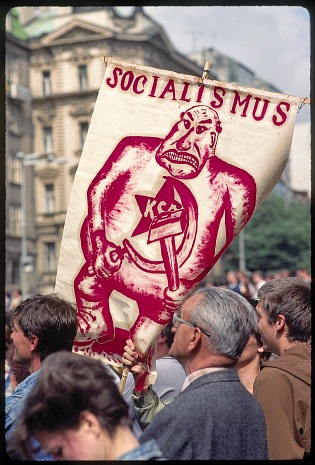 It's hard to believe all of this happened 19 years ago now.


