
I began using digital way back in 1999 with my now vintage FT100. Those early days of digital were experiments in the infancy of PSK31 and other modes available on the early beta programs at the time. It sure has changed. In 2004 I was on the beta test team for Ham Radio Deluxe testing and reporting bugs back to Simon Brown in Switzerland. HRD is now in the hands of a commercial company and it gets better with every new release. Yesterday I hooked up my KX3 to an Acer Aspire One. The Acer is a small portable laptop that sports 1GB of ram and a 160GB hard drive. When new it ran WinXP and last week I upgraded it to Win10 Home. I installed FLDIGI and it all ran just fine and used about 650mb of ram - so there was still some unused memory. It all ran just fine and made a contact with Mary, KC4TIE in Kentucky. She gave me a 599 report. I was running a 12 foot wire antenna and the internal tuner of the KX3 tuned it up on 20m with no effort. I was operating portable at the kitchen table with the power set to 3 watts. This will be my new portable setup for digital modes now. Next on the list is installing some JT65 software to see how this minimalist setup works decoding real weak signals.
Saturday, 27 February 2016

Wednesday, 13 August 2014
Canadian CBC Monitoring Station at Richmond Ontario c.1983
From my amateur radio collection of photos - these were shot on Ektachrome 100 way back in 1983. CBC used this station to record and re-broadcast BBC and other shortwave broadcasts for Canadian listeners. The station has been long gone but the original building is still there out on Fallowfield Road in Ottawa's rural west end. It may be a private residence now.


More photos to follow!
Sunday, 11 November 2012
If ye break faith with us who die We shall not sleep, though poppies grow In Flanders fields.


My father-in-law Noel, above, fought in the Royal Newfoundland regiment as a commando during the North Africa campaign and at Monte Cassino in Italy.
My nephew Tony Rusk, on his return from Afghanistan.

Above is my father on leave in London at Trafalgar Square sometime around 1943. He was in the Royal Canadian Air Force based at Tholthorpe near York. He was an air traffic controller for the duration of the war and boarded with a farm family. All four of the Baillargeon brothers returned home to Tecumseh Ontario after the war.

Wednesday, 24 October 2012
Band Conditions and DX
My apologies for not posting of late. Just too much going on but I do manage to get down to the shack late in the evenings. This has always been my favourite time to hunt DX. I’m a casual DXer and I don’t do contests. My work schedule allows for late nights and early morning operating times. I follow Hamspots.net, and operate digital and JT65-HF exclusively. I keep power levels below 20 watts and 99% of the time keep it at 10 watts out using my FT-950. I’ve done this even during the lowest parts of the 11 year sun cycle and still managed to work lots of rare and obscure stations. Often when the band seemed dead, out pops a rare South Pacific station and I snag them on the first call.


Earlier at 0445Z I worked Metin in Istanbul Turkey on 20m psk31. I noticed that I worked the Turkish and Tanzanian just after their sunrise times. I monitor this by reception reports displayed by PSKReporter maps and can watch the grey line creep along the countries that I’ve just worked. It’s a great DXer’s tool. It’s integrated into the current version of Digital Master 780.
Conditions have been really very good lately and urge you to get on the bands and work some of the rarer low power stations currently easy pickings during the late night hours on 20 meters and daytime DX on the busy 10 meter band.
Sunday, 7 October 2012
Draconid Meteor Shower And Incoming CME
This just arrived from Spaceweather.com:
DRACONID METEOR WATCH: Earth is about to pass through a stream of debris from comet 21P/Giacobini-Zinner, source of the annual Draconid meteor shower. Last year, Europeans witnessed a faint but furious outburst of 600 meteors per hour when the shower peaked. No such display is expected this year, but the Draconids are notoriously unpredictable. Northern-hemisphere sky watchers should be alert for slow-moving meteors emerging from the head of the constellation Draco the Dragon (not far from the North Star) on Sunday night, Oct 7th, through Monday morning Oct. 8th. Check http://spaceweather.com for more information and updates.
INCOMING CME: A coronal mass ejection (CME) is heading for Earth. The incoming cloud is expected to deliver a glancing blow to our planet's magnetosphere on October 8th, possibly sparking auroras at high latitudes.
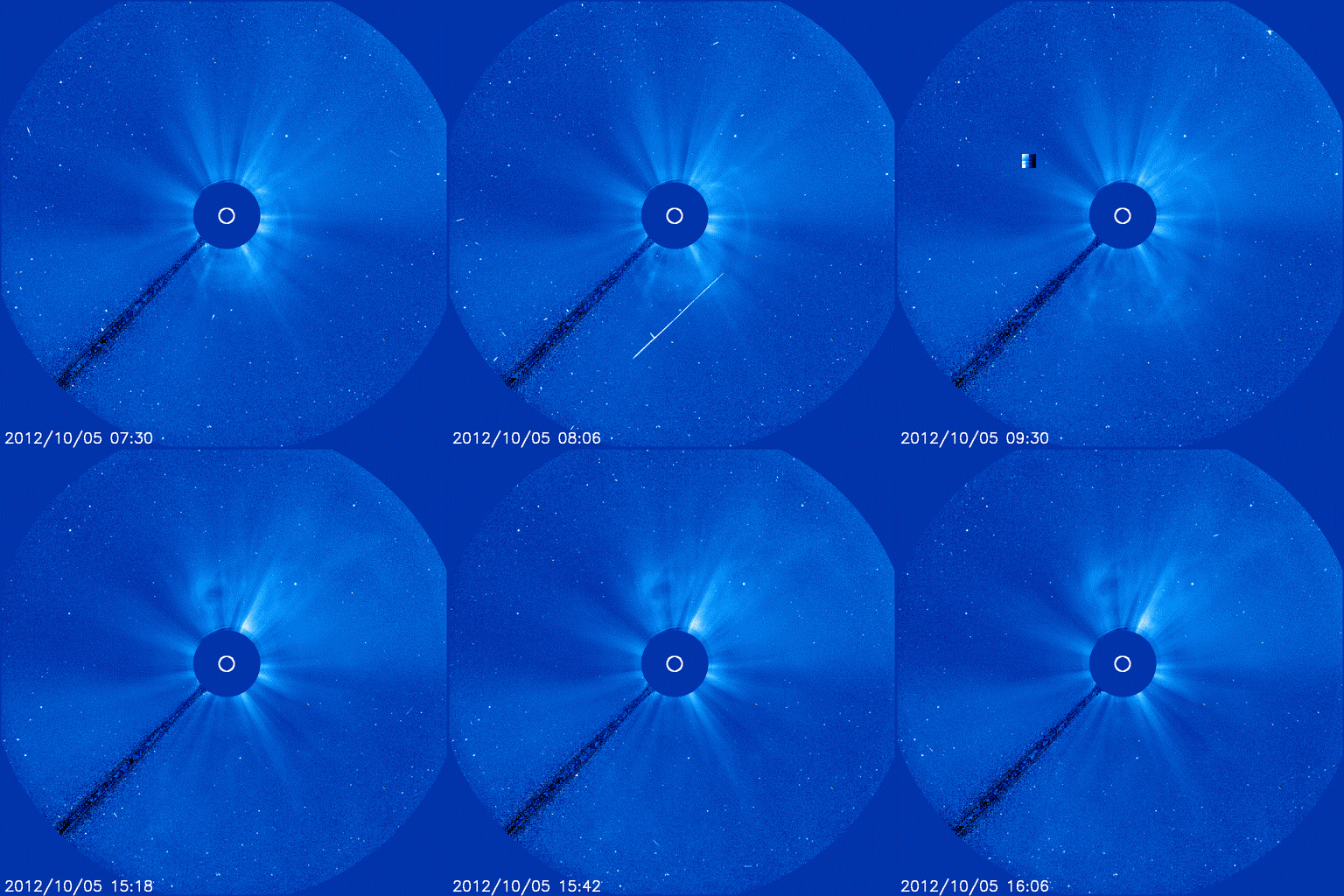
EARTH-DIRECTED CME: Magnetic fields near sunspot AR1582 slowly erupted on Oct 5th sparking a B7-class solar flare and hurling a CME toward Earth. The Solar and Heliosphere Observatory (SOHO) captured this image of the expanding cloud:
Friday, 5 October 2012
Fall and Puppy Linux In The Shack

Fall is a busy time out in the country where I live. It’s a time of getting gardens and lawn ready for winter. Other chores at the VE3MPG qth is getting the snow implements ready for the winter snow storms – getting the cutting deck off of the Kubota diesel and attaching the plow or blower onto the front, changing the oil and filter, attaching chains and 50lb weights to the back wheels for traction in the deepest snow. Some of our firewood has been delivered – nice hard maple and it’s all stacked nicely in our woodshed. I keep a good supply in the enclosed back porch and once every few weeks it’s replenished from the main supply in the woodshed. There are two airtight wood stoves here – one on the main floor and a large one in the basement. It keeps us cozy all winter, along with our geothermal heat pump.

At this time of year there’s often a lull too, where I find a few hours to try new software in the shack. I had an old 2004 vintage HP Pentium 4 computer sitting around. A few months ago I was reading about a very efficient Linux distro called Puppy Linux. This distro loads into memory, either from a CD or a thumb drive. On this antiquated HP machine software starts instantaneously because it all runs in fast memory instead of from a hard drive. Puppy runs much faster than Ubuntu or Windows on the same hardware. One of the Puppy distros that I discovered is a customized version by the PSKmail.org group.
Their Puppy DXpedition Disk includes many Linux amateur radio programs. Included are three logging programs, Fldigi for digital and PSKmail, satellite tracking, APRS software and many others.

There’s an excellent set of instructions included there on one of the links.
There’s also Puppy Linux Server CD available on the PSKmail.org site – it sets up a psk mail server running in ram and is a little larger distro than the DXpedition Disk distro. It includes everything for setting up a PSK mail server and a few other enhancements of interest to the Linux knowledgeable amateur.

This is the distro that I use in the shack – I installed it to a small hard disk and the system boots in about 10 seconds and runs from ram. I have 2 gigabytes of ram installed but it will run in a lot less. I’ll eventually have my FT-100 connected and running using psk mail on 30 meters. That’s a future blog posting coming up later this year. Puppy Linux is very easy to use and it will automatically recognize most hardware in your PC. It even included drivers for my old Realtek wireless card and configured itself to connect to my wireless internet network – easy peasy! I’ve been playing with variations of Unix/Linux since the early 1990s and this is one of the easiest flavours of Linux to learn on and play with. If you burn a CD/DVD of Puppy leave the disk open instead of finalizing the disk after burning the software image. That way you can add/configure new software and updates to your Puppy CD or thumb drive.
I do hope that you’ve enjoyed this blog posting. For you photography enthusiasts the photos at the top of the jelly and crab apples were taken with a Canon 10D SLR in RAW format and post processed in Adobe Lightroom. They were all shot with available light at 100iso at 6.3 megapixels.
Here are a couple of links of interest for today:

Ontario High Points for SOTA hams in Ontario

Friday, 28 September 2012
New Feature On The Blog
Ham radio is all about learning new things and keeping abreast of new developments in our hobby and in general. Broadening our knowledge base keeps the old mind active.
A new feature I’ve been wanting to implement on this blog is a Link Of The Day. Some days it will be included along with what I’m writing about or it will be a stand alone article that I find interesting, either about amateur radio, computers, science or a good old fashioned WTF type link. More often than not there will be at least two links that I find interesting and hope that you do too.
I hope you all find this new feature as interesting as I do.
Remember, you read it here first! – Bob VE3MPG
Links of the day:

Tin Foil Hats Actually Make it Easier for the Government to Track Your Thoughts

Thursday, 27 September 2012
10 Meters = Gud DX
10 meters is proving to be a fertile band for some good DX. I rarely use more than 20 watts here at VE3MPG. My preferred mode is digital; today I was monitoring 10 meters while getting some odd jobs done around the house and in the garage.
The great conditions on 10 remind me when I finally got my voice privileges way back in the early 1980s. After six months or a year, I can’t accurately remember I took my logs in to the Department of Communication here in Ottawa. The inspector had a look to see how active I had been on CW and stamped my log and gave me voice privileges on 160 and 10 meters. Ten in those days was very active and I installed a mono-band yagi on my roof up about 40 feet. Wall to wall signals and my TS-520 buzzed the ionosphere for many pleasurable hours working DX.
Back to today – my first contact was ZB3R in Gibraltar. I had worked Stephen a couple of weeks ago on 15 meters. Great signal and got him on the first call – power out about 15 watts to my Cushcraft R6000.
The second DX contact today was ZL4AD, Brian in New Zealand; again with 15 watts out and an honest 599 report from Brian. I’m using the latest Beta version of Ham Radio Deluxe for digital contacts and logging.
Now if the conditions continue into the weekend that would be great.
Thursday, 20 September 2012
St. Louis Vertical Part 3, Conclusion

This is part three, the conclusion of the construction of the St. Louis vertical.
I terminated each end of the twin lead by melting a small hole in between each conductor, large enough to fit a zip tie through and pulled in nice and tight. Then I stripped off insulation from each conductor and soldered them together – did this at each end of the twin lead coil. The bottom shorted conductor is kept bare and I use a good quality alligator clip to attach my coax center conductor. The orange wire is attached to a 17 1/2 foot counterpoise as seen below.


Here you can see the bright orange stake that I use in the field, along with the bright orange counterpoise so nobody trips over any of this stuff while operating portable.
Using alligator clips allows the use of multiple sized counterpoises to increase the efficiency of the St. Louis vertical while in use.
I carry a second stake with a 40 foot counterpoise. In this configuration the antenna resonates around 6.5Mhz. In a future version of this antenna I’ll add fewer turns of twin lead so it resonates close to 20 meters. I use an LDG tuner, the QRP Z11 along with my FT-817 and the tuner handles this antenna quite nicely.

The photo above shows the upper terminated connection with a male/female connector to attach the radiating element that extends to the tip of the Wonderpole. It provides an easy disconnect point for the radiating element.

These male/female connectors are available at most hardware stores that carry electrical supplies. I use heat shrink tubing to give all the connections a professional look and I think it extends the life of the antenna components. It doesn’t take long to add that extra finishing touch.

The antenna is staked on a ground spike used for beach umbrellas. It is a discontinued item that was available at Lee Valley Tools here in Ottawa. I attach a one inch wooden dowel about 3 – 4 feet long and to that I attach the St. Louis Vertical with large plastic zip ties. At the end of my session I just snip the zip ties off. The zip ties get the Wonderpole nice and snug against the non-reactive wooden dowel and if need be I can hammer some of the extra length of the wooden dowel into the ground for greater stability during windy conditions. I sharpened the end of the dowel for ease of insertion.

Here’s the St. Louis Vertical fully extended at the edge of my patio. This antenna is a great portable addition to operating in the field and it sets up in less than five minutes. My first contact was on 15 meters using 2 watts on PSK31 to a station in Slovenia with a 599 signal report.
Please let me know if you have any questions of the construction details.
Wednesday, 19 September 2012
St. Louis Vertical Part 2 of 3
This article is part 2 of the construction of the St. Louis Vertical – a continuation of part 1 that I published a couple of years ago. You can head over to part 1 of the construction article here.
Continuing from grinding down the Wonderpole clips I further grind them down with the Dremel tool so they are flush with the tube; this will allow the twin lead to lay flat along the body and also allow the adhesive to better cover the tubular shape of the Wonderpole.
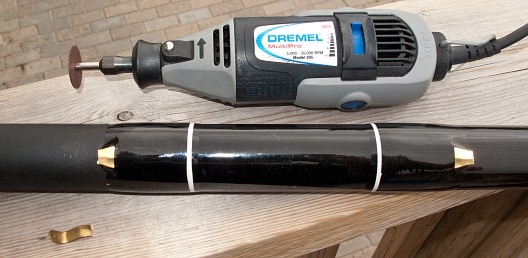

The next step caused me to think very carefully on how to wrap the twin-lead onto the Wonderpole. I had read on various sites describing how hard this was going to be. Some described it as a two man operation to ensure that the twin-lead was wrapped tightly around the pole. Hmmm, this was going to be a problem unless I figured an easy method to accomplish this task. Of course thinking about these last two years I finally came up with a solution. Enter some 3M Indoor/Outdoor carpet tape. Man this stuff was sticky but I think it would hold and as it turned out was an elegant solution.

The trick was to apply the tape every inch or so, keeping the backing on until I reached the next inch while turning, by hand, the twin-lead. This was hard work and each time I stopped to rest my aching hands I attached a zip tie to hold the stiff twin-lead in place. Eventually I surmised that additional tape was needed so I eventually covered the entire length of the pole as I wound the twin-lead.

There was still a problem – the stiff twin-lead was pulling away despite the extreme stickiness of the 3M tape. Thinking quickly now as I was at least two hours into winding this twin-lead on the pole. I went to my workbench in the garage where I do the occasional refinishing work on antiques. I use a Black & Decker heat gun to lift old paint from projects I’m working on. I figured if I heated the twin-lead sufficiently it would take on the cylindrical shape of the pole – an it did – it worked great, though I kept the zip ties on just in case.
You can see my progress in the photo below. The white tape backing is removed to expose the sticky backside of the tape; and you can see the zip tie in place while I rest my hands for awhile.


I had a good supply of RCA twin-lead that I had purchased about 10 years ago at Princess Auto, a surplus type store located across Canada. Of course halfway through construction I had neglected to figure out how much of the 50 foot length of twin-lead I needed. A quick calculation of number of turn per inch showed that I would have almost five feet left over. That horseshoe was working overtime now…with this important information in hand I continued winding until I reached the end of the pole. I still have a 50 foot length and a 100 foot length set aside for other projects using twin-lead.

The picture at the left shows detail of the zip tie and the double sided tape exposed for winding. Every few inches I would fire up the heat gun to meld the twin-lead to the pole shape.
After almost three hours I had completed the toughest part of constructing a St. Louis Vertical and took a good rest before continuing this homebrew antenna.
Part 3 to follow tomorrow.
Tuesday, 18 September 2012
Sean Smith, KG4WSS, Killed in Consulate Attack
From the ARRL this afternoon -
09/18/2012

Smith is survived by his wife, Heather, and two young children, Samantha and Nathan. “They will grow up being proud of the service their father gave to our country, service that took him from Pretoria to Baghdad, and finally to Benghazi,” Secretary of State Hillary Rodham Clinton said in a statement.
Read the entire story here at the ARRL website.
Chilicon 2012–A Resounding Success
The annual Chilicon put on by the Ottawa Valley QRP group turned out to be a resounding success despite torrential rainfall on Friday night. This didn’t dampen those hardy campers from fulfilling a superb fun filled weekend at the Rideau River Park along the beautiful Rideau River near Kemptville.
I operated by small portable station, an FT-817, my NUE-PSK digital qrp modem, and my experimental version 0.06 St. Louis vertical (construction article coming up in my next posting here). Didn’t get as much operating done due to the nature of amateur radio ops being out in the wild. Most of the day encompassed walking around to various sites rag chewing with the various operators and admiring the ingenuity of their portable setups. There was some very nice equipment and innovative antennas and Mike’s (VE3WMB) homebrewed magnetic loop gave me a few ideas for one of my own. I managed to work a station in Slovenia with 2 watts out to my St. Louis Vertical, so it’s doing a very good job of getting out for a hastily constructed portable antenna.
I met some old friends at Chilicon this year as well as many new faces and I do hope that next year’s Chillycon (renamed due to lack of actual chili, but aptly re-badged to reflect the frigid night temperatures endured by the hardy group this year and last.)
Here are a few photos that I managed to take in between operating and chatting with the QRP members.


An excellent weekend despite rain on Friday and a little on Saturday. The weekend culminated with some very large excellent pizzas from a local restaurant in Kemptville.
Conspicuous by his absence was Martin VA3SIE who had to work and we’re hoping to see him next year. Martin, there was an excellent cache of single malt scotches at one of the campsites if that’s any enticement for attending next year’s “Chillycon”.
The OV-QRP Yahoo group can be found here for more details on this year’s Chilicon.