Wednesday, 24 December 2008

A Season's Greeting To All Good Readers

I would like to thank all readers of my blog for making it a success. A season of giving and renewal is upon us and I hope that each and every one of you finds the time and energy to help those less fortunate. If you know someone who’s spending time alone during this holiday season call them or have them in for a meal or invite them out for a coffee and donut.

I also hope that you all find some amateur related goodies under your trees in the morning.

See you all on the air, Christmas Day, for a few hours.

Imagine all the people living life in peace. You may say I'm a dreamer, but I'm not the only one. I hope someday you'll join us, and the world will live as one.
- John Lennon

Saturday, 20 December 2008

3B8GT, Mauritius

Ham radio has been slow here at VE3MPG. I do get on most mornings just to listen around and I work PSK 99.99% of the time. It’s just a lot easier than trying to decipher SSB sigs with my less than perfect ear.

mauritius_map1 I was on this morning just before lunch and heard VE3JW, the amateur station over at the Museum of Science and Technology about 24 Kms to the north of me. Darin, VE3OIJ was just signing with a station, 3B8GT. Had to look that one up; and quickly, after Darin’s final, I got a call in to that DX station. He responded with a 599 and he was strong here too with some QSB. 3B8GT is the island of Mauritius about 900 kilometres to the east of Madagascar and east of Reunion Island in the Indian Ocean. A good catch indeed with all of 20 watts reaching my Cushcraft R6000 vertical. I’m not really sure how much signal reaches the antenna as I’m feeding it with 100 feet of RG59 el cheapo coax. That’s 75 ohm coax, but my FT-950 swr meter tells me there’s no reflected power. Let’s say that less than 20 watts gets radiated. The Museum uses a beam but I was hearing the Mauritius station Q5 here.3b8gt

The op on Mauritius is Alexey 3B8GT with a very modest station according to his QRZ.com listing – 50 watts to a 3 element yagi. Conditions seemed to be perfect this morning but looking at the solar terrestrial data indicated the solar flux at 69, A-index at 2 and the K-index at 0. Not so good propagation it says. Nevertheless the actual working conditions seemed excellent at the time. Local temperature was –17C, crisp and sunny. When I signed with Alexey I hung around a bit to see who might work him but he called CQ for a good ten minutes and no takers. My strategy is to look for weak traces on the waterfall and try to work those stations – usually they turn out to be some good DX. Last spring I worked Reunion Island late in the evening on 20 meters using this strategy – it took me a week to snag him due to pile ups he was generating. That contact was using a 20 meter hamstick and 20 watts.

Another PSK31 tip:
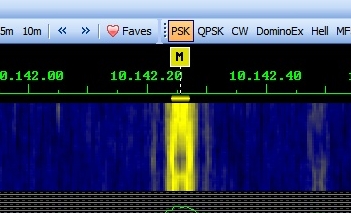
Use the center of your waterfall. Testing will show that your transmit (TX) and receive (RX) will be strongest there. Don’t blindly use 1000Hz tone or strictly follow the VFO ‘set it and forget it' concept. You can easily lose 20% or more of your power on each edge of your pass band. Pass band centering of the signal will give the best results of both RX and TX.

CIA World Fact Book on Mauritius

Sunday, 7 December 2008

A Good Cold Snap


Winter has arrived in the Capital, Ottawa. Power is out this afternoon to about 17,000 people on the outskirts of greater Ottawa. There's been some terrible winds in excess of 50Km/hr and gusting higher out here near Metcalfe about 19 miles south of Parliament Hill. Temperatures have been dropping all day and stand at -12C at 3pm. Expected low temperatures overnight will hover around the -20C mark and that's not including the wind chill. Affected areas include: Orléans, Alexandria, Alfred, Clarence, Cumberland, Hawkesbury, North and South Plantagenet, Osgoode, Rockland, Russell, South Gower, and Winchester.

I've been listening to the Emergency Measures group repeater VA3MV, 146.985- (100.0Hz tone) but there's not much going on. Power in FN25fe has been on all day with no hiccups so far and the band conditions have been very very good on 20 meters. Last night 40 meters was extremely quiet; so quiet that I kicked in the preamp on the FT-950 so I could hear band noise. Signals really jumped out of the noise floor with very deep qsb on all the sigs.

My R6000 is surviving the windy onslaught largely due to the guying I installed when it went up a few weeks ago. I can see a very slight side to side movement of a couple of inches which isn't too bad. The PAR end fed dipoles of course are rugged enough for even Arctic use, which today's weather approximates very well.

Friday, 28 November 2008

Unconventional Antennas from NASA Labs

Yes, I know I'm writing a lot about NASA, the Jet Propulsion Labs, and space stuff in general. This interests me a lot, anything to do with space travel and its related technology. I still remember watching the historic moon land in 1969 on our first Zenith colour TV. You've probably noticed too that I like working with different antenna technologies.

I ran across a NASA article that describes their antenna design software. It's nothing like what's available to the ham community. Their software takes ten hours to design new antennas for their satellites and spacecraft. You can imagine the criteria as to size, weight, and performance required for operation in deep space.

Here's what their computer clusters have managed to design - very unconventional - it looks like a bent paper clip but their computers have determined this is the best performing hardware for their satellites.


NASA describes their software, that runs on a network of personal computers as "evolutionary". The above photo shows an antenna that can fit into a one-inch space (2.5 by 2.5 centimeters) in front of 'borg' of computers.

"The AI software examined millions of potential antenna designs before settling on a final one," said project lead Jason Lohn, a scientist at NASA's Ames Research Center, located in California's Silicon Valley. "Through a process patterned after Darwin's 'survival of the fittest,' the strongest designs survive and the less capable do not."

The software started with random antenna designs and through the evolutionary process, refined them. The computer system took about 10 hours to complete the initial antenna design process. "We told the computer program what performance the antenna should have, and the computer simulated evolution, keeping the best antenna designs that approached what we asked for. Eventually, it zeroed in on something that met the desired specifications for the mission," Lohn said.

When I visited the JPL in Pasadena California in April of this year I discovered a group of hams working there and they had a JPL ham club and repeater. Bets that some hams had a hand in this software. Now if they could only release the software to us lowly hams who use wire antennas and minimalist stealth antennas. I need something this small on 160 meters.

NASA 'EVOLUTIONARY' SOFTWARE AUTOMATICALLY DESIGNS ANTENNA

JPL Amateur Radio Club

(Photos courtesy of NASA Ames)

Monday, 24 November 2008

NASA Tests First Deep-Space Internet

NASA Jet Propulsion Laboratory (11/18/08)


Some exciting new communication technologies are sure to emerge from these new protocols - they may even trickle down to amateur digital modes.


NASA Jet Propulsion Laboratory (JPL) engineers have successfully tested the first deep space communications network based on the Internet, using the Disruption-Tolerant Networking (DTN) protocol to transmit dozens of images to and from a spacecraft more than 20 million miles from Earth. NASA and Google's Vint Cerf jointly developed the DTN protocol, which replaces the Internet's TCP/IP protocol for managing data transmissions. "This is the first step in creating a totally new space communications capability, an interplanetary Internet," says NASA's Adrian Hooke. An interplanetary Internet needs to be strong enough to withstand delays, disruptions, and lost connections that space can cause. For example, errors can happen when a spacecraft slips behind a planet, or when solar storms or long communication delays occur. Even traveling at the speed of light, communications sent between Mars and Earth take between three-and-a-half minutes to 20 minutes. Unlike TCP/IP, DTN does not assume there will be a constant end-to-end connection. DTN is designed so that if a destination path cannot be found, the data packets are not discarded but are kept in a network node until it can safely communicate with another node. In October, engineers started a month-long series of demonstrations, with data being transmitted using NASA's Deep Space Network twice a week.


Researchers say the interplanetary Internet could allow for new types of complex space missions that involve multiple landed, mobile, and orbiting spacecraft, as well as ensure reliable communications for astronauts on the surface of the moon.

NASA Tests First Deep-Space Internet

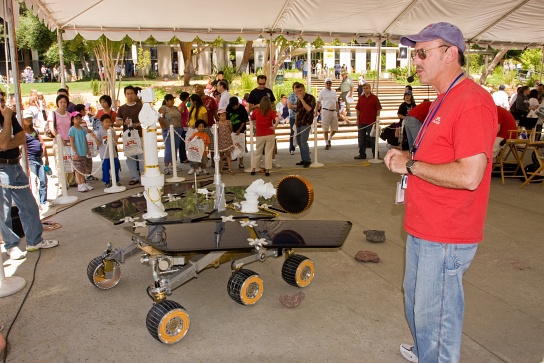
(photos were taken at the NASA JPL in Pasadena California, during my visit there in April 2008)

30 Meter Weekend

30 meters was very busy this weekend but I didn't get to operate very much due to a GTD (getting things done) list. The little time I did have to operate worked out quite well. I tried my hand at Olivia mode. I had just finished reading in the December08 QST about this magic mode and made a nice contact to W9NWR down in Wisconsin. Copy was excellent and it's expected of this mode. Though Chuck's signal was full copy with Digital Master 780 he wasn't moving the S meter. Olivia presented perfect copy with no effort on my part. I had the pre-amps off in the FT-950 and about -6dB of attenuation - just enough to lower the band noise. I like Olivia but it is a really slow mode of communications. I can see using it under extreme band conditions where noise is bad or the signals are not visible in the waterfall. At least I could keep the buffer full with my typing.

The next morning I snagged some good DX just before heading out for a Sunday filled with activities. ES0IC, Meeme, on the island of Kassari (IOTA-EU034) in Estonia on PSK31. He was 599 copy on my PAR EF-30 end fed dipole. A really nice contact and great DX to boot. I noticed many DX stations operating Sunday morning. Sunday night was good too and the band stayed open well past 10:30pm local time. A strong Puerto Rican station, WP3UX, was calling CQ for at least a couple of hours. On Saturday night the band closed just after sunset.

If you haven't tried 30 meters give it a go. It's a great DX band, only digital and CW modes are permitted (no contests!), and if you hit it right there's a lot of great DX to be had. All contacts on the weekend were completed using 20 watts output and using my FT-950. The 950 dsp filtering options are great for digital work.

To keep tabs on 30 meter DX activity I was using a new DX cluster called DXAnywhere programmed by a young British chap, Peter, M3PHP. Peter says, "The system also includes a full blown social networking system where users can setup profiles of themselves and their amateur radio background and become friends with other users! We're also keen on keeping the system fresh so on a monthly basis we're going to be adding new applications into the mix."

Friday, 21 November 2008

30 Meter Digital Group 1 Year Anniversary Weekend


For all of you digital mode enthusiasts this is the perfect weekend for testing those 30 meter antennas and setting the bandswitch to 30 meter position.

The 30 Meter Digital Group is celebrating their one year anniversary this weekend. The activity starts this weekend November 22nd and 23rd.

10.140 USB +/- 1000 PSK

(10.132 – 10.145 – HELL, OLIVIA, MFSK, RTTY, WSPR, PropNet, Etc)

10.140 +2000 – 30MDG Members Dedicated Hours from 1900z to 2200z - 30MDG members look for other members to ragchew with further up the waterfall.

Let's celebrate our 30MDG 1st year anniversary and have some fun on the 30 Meter Band! The 30 Meter Digital Group would like to invite our 1,350 plus members along with any and all digital operators for a casual digital weekend on the 30 Meter Band.

Those that are 30MDG members this would be a good time to mark your calendar and meet up with other 30MDG Members for a ragchew or meet a DX member. You do NOT have to be a 30MDG member nor join the 30MDG to participate; just get on the 30m band and have some digital fun!

Our 30 Meter Digital Group promotes:

- Awareness of the unique 30 Meter Band (note: we are SECONDARY USERS
of this band and must give way to Primary users so please use good operating procedures)

- Proper digital mode operation and procedures

- Experimenting with different digital modes, power, antennas, etc.

- Low power operation and only using the least amount of power needed for the contact at hand (note: 75% of digital mode operators use between 20-40w on the band…also note for U.S.A. operators the 30m band is a great place because we must use <200w so we are all on the same playing field on the 30 meter band…oh yes, no voice for U.S.A. ops so it is really an all digital band)

- Casual operating on the 30 Meter Band from ragchews to DX but we do NOT promote Contesting….30 Meters is a WARC band and one place we all can enjoy away from contesting.

- Increase 30 Meter digital mode use on this under used unique band that has the best of both 20 Meter and 40 Meter propagation because it sits between them (again note we are SECONDARY USERS)

Here at VE3MPG I use the PAR EF-30 End Fed Dipole on 30 meters. I'll report after the weekend on conditions and activities.

Yahoo 30 Meter PSK Group

30 Meter Digital Group

30 Meter Antennas

Arnie Coro CO2KK talks about 30 meters