Some members of the Ottawa Valley QRP Society joined ranks today at Hampton Park. The exercise was a dry run for the much anticipated Field Day on June 26 – 27th. Here are a few snap shots of the QRP nuts enthusiasts enjoying the day this holiday weekend.
Saturday, 22 May 2010
Field Day Dry Run – Ottawa Valley QRP Society
Just When I Thought It Was Safe
You know, I’m a cautious kind of guy. I know that every activity is fraught with peril but little did I know that QRPers were nut jobs. Yes that’s the new diagnosis for being passionate about low power operating or better known as a QRP operators. Now the professions who treat psychiatric disorders have a new (un)treatable disorder on the books. Read this post by KE9V on his blog titled “Low Powered Nut Jobs.” Now I must get this news out to the Ottawa Valley QRP Society.
Monday, 17 May 2010
FT-817 Gets Updated After 9 Years
My trusty little FT-817 is getting a CW filter. I’ve had the 817 for 9 years now and it has never let me down. I have the original 817 not the 817ND version. I’m preparing for Field Day with the Ottawa Valley QRP Society and I’m trying to improve my CW proficiency in time for Field Day 2010, scheduled for June 26th and 27th – the last weekend in June. Even if I don’t reach my goal I’ll use the 817 on PSK. The 500Hz filter should help in that situation too. I also have a new PAR EF-10/20/40 End Fedz QRP antenna on the way. Dale, of PAR Electronics has informed me that between May 21st to the 27th is when he’s taking amateur orders for his End Fedz antennas. He’s extremely busy with his commercial and mil orders when he’s not fulfilling amateur orders.
I want to add that I have had 2 PAR End Fedz (EF-40 and a EF-30) installed as permanent antennas for 2.5 years; they still operate and look like new. Don’t hesitate to use Dale’s antennas in permanent locations. If they can survive Ottawa’s extreme weather conditions they can survive just about anywhere. Highly recommended for either portable or permanent locations. I keep a spare EF-20 in my go kit just in case.
Field Day equipment will include my FT-817, an FT-100 as a spare transceiver, a 15W solar panel and charge controller for my 12V 18A/H gel cell, the PAR antenna and a Buddistick as a spare antenna. I’ll be taking along my Honda EU2000i gen set to run my laptop throughout the operating period.
The bands have been lousy lately and the sun is quiet, no sunspots. Despite the conditions there’s DX on everyday. 17 meters is open as a write this at 20:30Z. Ukraine, Russian and Italian stations are on the PSK section of the band with Americans having QSOs in the phone portion of the band.
Tuesday, 4 May 2010
Summer Storms And Your Shack
The summer storm season is here. As I type this there’s a lightning storm passing overhead. My antennas are disconnected and my gear is unplugged and protected with good quality uninterruptible power supplies when in use. We get some extreme variations with line voltage here. A few winters ago line voltage had dropped to 107V AC and my UPSs, all 4 of them started beeping in unison. A quick call to Hydro One and they discovered most of our rural road had low line voltage – not good for appliances. I did lose 2 circuit boards in a front loading microprocessor controlled clothes washer either from low voltage or summer storm activity – the washer and dryer get unplugged if I think about it too.
I make sure when leaving the house, even on sunny days to disconnect the station. I’m located about 23Kms from city center. We seem to have a micro-climate south of the city and summer and winter storms that bypass the Ottawa manage to hit us out here.
On the bands: 10 and 6 have been open and lots of stations on if you manage to get on when those openings occur. There’s a slew of sunspots this week making for some great DX on the higher ham bands.
Photo courtesy of Sebastien D'ARCO
Sunday, 2 May 2010
20 Meter DX – Band Wide Open At 04:15Z
It’s early morning (04:15Z) out here in the south of Ottawa. 20 meters is wide open and DX stations fill the digital portion of the band. Lots of Pacific stations and quite a few Asiatic Russian stations on the air this morning. Background noise is undetectable. I have the AGC in the FT-950 in the OFF position to better hear the weak stations on PSK. I’ve just worked UA0ZAY Igor, on the Kamchatka Peninsula. I hear Hawaii calling CQ with mostly stateside stations responding. I’m on the Cushcraft R6000 this morning running about 30 watts.
Earlier I had worked UA0ZK, Vasily, also on Kamchatka. Signals were all 599 and perfect copy. If you’re a night hawk there’s DX to be had with very little effort.
The Volcanoes of Kamchatka are a UNESCO World Heritage Site. Photo courtesy of Wikipedia.
Friday, 30 April 2010
St. Louis Vertical Part 1 - Prep
The St. Louis Vertical portable antenna has been talked about and modified over the years. It’s a very portable antenna solution for Field Day or QRP enthusiasts. It’s easy to build and modify and covers 40 meters to 10 meters with the use of a tuner. Radials are a must with this type of antenna. I use a Shakespeare Wonderpole, a collapsible fishing pole. Fully extended it’s 20 feet long and collapses to 45 inches for storage and transport.
Years ago I purchased a good amount of Radio Shack twin lead for this project and like any good ham I’m finally getting around to building a St. Louis vertical for use at Field Day and with the Ottawa Valley QRP Society group outings.
The first preparation that must be done on the Wonderpole is the removal of the two clips midway up on the first section. These two brass clips are used to hold a fishing reel. The reason for removing these two clips is to assure that the twinlead once wound on the lower section is flat against the bottom section when you wind it on. It’s more esthetics and it makes it easier to wind without the bumps of the clips underneath the twinlead.
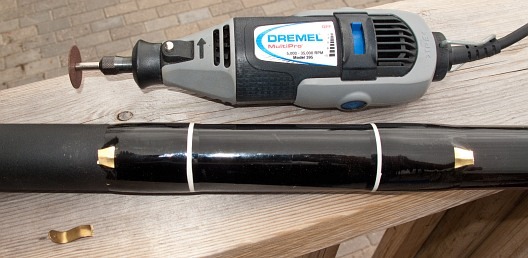
I used a Dremel tool with a cutting disk attached to cut through the clips. I still have to smooth down the plastic adhesive used to attach the clips with a small grinding tool attachment on the Dremel.
For the last while I’ve been thinking quite hard to determine a good way to wind the twinlead onto the bottom section so it stays in place. In part 2 of this series I’ll show you a novel method that I devised to accomplish this – it’s weatherproof too.
Have been listening to 17m psk this afternoon and just finished working A71EM in Qatar with 40 watts on the R6000 vertical. 17 is a fine band with some great DX and quiet band conditions – opportune for working DX. It seems to be open early morning till sundown here near Ottawa – always with some exotic stations waiting to be worked.
Here’s a link from the American QRP Club describing the St. Louis Vertical:
Tuesday, 27 April 2010
April 27, 1791: Samuel F.B. Morse
Samuel F.B. Morse, inventor of the Morse Code was born on this day, April 2tth 1791. His invention was patented in 1837, and he gave the first public exhibition of his device to scientists the following year.
Read More http://www.wired.com/thisdayintech/2010/04/0427samuel-fb-morse-born/