Showing posts with label FT-950. Show all posts

Wednesday, 24 October 2012

Band Conditions and DX

My apologies for not posting of late. Just too much going on but I do manage to get down to the shack late in the evenings. This has always been my favourite time to hunt DX. I’m a casual DXer and I don’t do contests. My work schedule allows for late nights and early morning operating times. I follow Hamspots.net, and operate digital and JT65-HF exclusively. I keep power levels below 20 watts and 99% of the time keep it at 10 watts out using my FT-950. I’ve done this even during the lowest parts of the 11 year sun cycle and still managed to work lots of rare and obscure stations. Often when the band seemed dead, out pops a rare South Pacific station and I snag them on the first call.

IMG_1580Just yesterday I worked Tanzania, 5H3NP, Noel, at 0400Z on 20m psk31 running all of 15 watts. Noel had a good clear signal and he told me he’s on every night at the same time. I did hear him the previous evening but he was working Europeans and Russian stations in a pile up.


d2qrA couple of days ago, on 10 meters Serg, D2QR was on from Angola; again a nice strong signal and worked him on his first CQ call. The call looked familiar and checked my log and sure enough I had worked Serg in 2004 on 20 meters.

Earlier at 0445Z I worked Metin in Istanbul Turkey on 20m psk31. I noticed that I worked the Turkish and Tanzanian just after their sunrise times. I monitor this by reception reports displayed by PSKReporter maps and can watch the grey line creep along the countries that I’ve just worked. It’s a great DXer’s tool. It’s integrated into the current version of Digital Master 780.

Conditions have been really very good lately and urge you to get on the bands and work some of the rarer low power stations currently easy pickings during the late night hours on 20 meters and daytime DX on the busy 10 meter band.

Thursday, 27 September 2012

10 Meters = Gud DX

10 meters is proving to be a fertile band for some good DX. I rarely use more than 20 watts here at VE3MPG. My preferred mode is digital; today I was monitoring 10 meters while getting some odd jobs done around the house and in the garage.

The great conditions on 10 remind me when I finally got my voice privileges way back in the early 1980s. After six months or a year, I can’t accurately remember I took my logs in to the Department of Communication here in Ottawa. The inspector had a look to see how active I had been on CW and stamped my log and gave me voice privileges on 160 and 10 meters. Ten in those days was very active and I installed a mono-band yagi on my roof up about 40 feet. Wall to wall signals and my TS-520 buzzed the ionosphere for many pleasurable hours working DX.

Back to today – my first contact was ZB3R in Gibraltar. I had worked Stephen a couple of weeks ago on 15 meters. Great signal and got him on the first call – power out about 15 watts to my Cushcraft R6000.zb3r_StephenStephen uses an FT-950 and you can see how professional his station looks. Have a look at his QRZ profile for more pictures of Gibraltar itself and more about Stephen’s station.

The second DX contact today was ZL4AD, Brian in New Zealand; again with 15 watts out and an honest 599 report from Brian. I’m using the latest Beta version of Ham Radio Deluxe for digital contacts and logging.

Now if the conditions continue into the weekend that would be great.

Tuesday, 28 August 2012

Here We Are, Again

Here’s my first blog post in a good long while. I figured it was time to get things going again and this post will be about some current projects here at VE3MPG.

A station photo is in order now that the shack is clean and tidy (somewhat). This varies day to day, hour to hour.
 Bob Baillargeon VE3MPG-3278
 Bob Baillargeon VE3MPG-3271
I’m located in part of the basement called the “bunker” – 2 windows, one facing due south the other to the east so I get some nice sunlight most days even during the winter months. Power to the station is supplied by a dedicated 120V line and a second, share 120V line. Both have APC uninterruptible power supplies to condition and smooth the AC coming into the shack. In the event of low voltage or complete loss of power the APC units shut down the computers gracefully and a small utility lets me monitor line voltage and power interruptions. The APC units prevent power surges from reaching my equipment, but a good ground is necessary.

The next posting will be about Part II of the St. Louis Vertical article from April 2010. Hope to be completed with testing and construction in time for the annual Chilicon qrp outing at the Rideau River Campground on September 14th and 15th sponsored by the Ottawa Valley QRP Society.

That's it for now.

Monday, 19 July 2010

Great Weekend With DX

Weather in the Ottawa area was superb this weekend. BBQs and relaxing outside were the order of the day. Temperatures moderated to the mid-20s (Celsius) on Sunday. This necessitated some outdoor relaxation and a good book.

After dinner I started listening around 17 meters. There were a few signals but not a lot of DX. A few minutes later I saw the S-meter on the FT-950 hitting S9. A digital station was very loud; and there was a pile-up starting on frequency. It was 2330Z and usually at that time of day the band is closed. With little solar activity I was surprised by the strong signals on 17 meters.

pz5ra_1 The station was Ramon PZ5RA in Suriname. I had worked Ramon in 2004 and again in 2007 on digital modes, using my FT-100 in those days. I finally worked Ramon after 30 minutes using BPSK125 – makes a QSO whip along quickly. I kicked in about 12dB of attenuation because he was so strong on my Cushcraft R6000. About 10 minutes after the QSO the band dropped out – silence – not a signal. I suspect Ramon will be hanging around 17 meters since the band was in good shape for north/south propagation. Maybe we’ll get a repeat tonight and more stations will be able to work Ramon in Suriname.

Friday, 9 July 2010

Late Night DX On 20 Meters

It’s out there. Last night saw me re-connect with Bill, ZL3NB in Christchurch New Zealand at 0437Z. His signal was 599 and his report to me was the same. There was some QSB but armchair copy using Ham Radio Deluxe and PSK31. My output was set to 25 watts and again this was using my Cushcraft R6000. That’s a distance of 8835 Kms or 14218 miles. Not bad for a low power digital QSO.

ZL3NB_Bill

I had originally worked Bill in April of 2004 and I happened to be one of his first digital contacts at around the same time at 0358Z six years ago. It was nice re-connecting with Bill. He worked a couple of more stations after my QSO and then called CQ for a long time. It was time for bed knowing there was lots of DX floating around despite the low sunspot numbers.


ZL3NB_Station

Bill’s ham shack in New Zealand. The main equipment consists of a Kenwood TS2000 and TS530S (Classic setup with the VFO240 and SP230) along with a Ameritron Amp. Antennas consist of a Mosley TA33 tribander and inverted vee's for 80/40 and 30 meters.

I suspect there’s more DX at that time of the morning, rolling in from the South Pacific area – I just ran out of steam and had to pull the plug.

The steamy heat wave enveloping Ottawa finally broke early this afternoon with some rainshowers and thunderstorms. Temperatures plummeted to +23C and power went out for a few short seconds. It’s time to leave antennas disconnected and grounded before these intense summer storms move into the area. It’s good practice and could save you a bundle if there’s ever a lightning strike close by.

For more info on Christchurch go to: www.christchurch.org.nz

Thursday, 8 July 2010

DX Is Out There

There’s DX to be had on the higher bands despite the low solar activity. A few hours ago I worked UT3UA UT3UA, Sergey in Kiev, Ukraine. This was on 20 meter psk close to 1 am in the morning local time here near Ottawa (0441Z). Another, EV1P, Vlad in Minsk, Belarus at 2231Z on 20m psk. All contacts were using 20 watts into my Cushcraft R6000 vertical and my Yaesu FT-950. Signals were 599, good solid contacts.

I use Ham Radio Deluxe with the latest build – it fixes some lookup issues with QRZ.com. I sometimes use the DX cluster clients but usually I just casually listen around the bands, even if they sound dead. ZL stations were booming in that same morning on 20 calling CQ with few answering his calls.

Beacons are another favourite method of determining band openings. My favourite and most up to date site is G3USF's Worldwide List of HF Beacons. Martyn is the RSGB Propagation Studies Committee chairman and does a good job of keeping his lists up to date.

In other news, Ottawa is still in the grips of a major heat wave. Temperatures south of the city this afternoon sit at +36C. It’s downright uncomfortable even in the shade.

RoswellDailyRecordJuly81947-660x464 July 8th is also a significant date for UFO enthusiasts. The Roswell incident happened on this date way back in 1947 – it’s still a controversial subject still much talked about on UFO and conspiracy web sites.

The Roswell Daily Record headlined the story “RAAF Captures Flying Saucer on Ranch in Roswell Region,” providing a historical artefact that, in retrospect, seems ready-made for fuelling an episode of The X-Files. The truth is out there. . . . and so is DX.

Radio Society of Great Britain

Roswell Incident Launches UFO Controversy

Monday, 31 May 2010

10 Meters And 6 Meters

Ten and Six have been crowded with signals the last few days. I’ve worked Puerto Rico and to the American mid and south west with good signal reports. Both bands remained active until well into the evening. There’s a good chance these two bands will remain active for the next few hours. Low noise on 10 meters make it really great to work weak stations on digital modes. I’ve noticed before noon noise is extremely low as well as the signals. But whatever I could hear on my FT-950 and the Cuschraft R6000 vertical, I could work. Shortly after the lunch hour noise increased but so did the signal levels. There’s some great DX if you’re patient and make use of the DX clusters.

Sunday, 2 May 2010

20 Meter DX – Band Wide Open At 04:15Z

ua0zay

It’s early morning (04:15Z) out here in the south of Ottawa. 20 meters is wide open and DX stations fill the digital portion of the band. Lots of Pacific stations and quite a few Asiatic Russian stations on the air this morning. Background noise is undetectable. I have the AGC in the FT-950 in the OFF position to better hear the weak stations on PSK. I’ve just worked UA0ZAY  Igor, on the Kamchatka Peninsula. I hear Hawaii calling CQ with mostly stateside stations responding. I’m on the Cushcraft R6000 this morning running about 30 watts.

Earlier I had worked UA0ZK, Vasily, also on Kamchatka. Signals were all 599 and perfect copy. If you’re a night hawk there’s DX to be had with very little effort.

ua0zk

Petropavlosk Kamchatsky harbour_sm

The Volcanoes of Kamchatka are a UNESCO World Heritage Site. Photo courtesy of Wikipedia.

Tuesday, 24 March 2009

Antennas Survive Ottawa Winter

My antenna farm survived the brutal, windy, snowy, freezing rain type weather known in this neck of the woods. Some good planning, engineering and blind luck allowed my PAR EndFedz and my Cushcraft R6000 to survive unscathed through the arctic like conditions up here. A 3-point guy system protected my R6000 from self-destruction. The PAR EndFedz were securely anchored with enough slack to survive the windy conditions south of Ottawa. We do get some extreme winds out here. A couple of years ago, during a micro-burst type summer storm I lost some siding on the upper story of my home. Anything not anchored down gets blown to the next county.


DX has been hit and miss but throughout the season there's been some good conditions favourable for long haul communications. D44TXF on Cape Verde - 17m, NH6I Hawaii on 40 meters, ES3RM - Estonia on 17m, 5D0IPY - Morrocco on 17m, ZS6GAV - South Africa on 17m, and many more. The 17 meter band has been open during the very early morning hours during dawn and stays open for at least a couple of hours. Despite the low sunspot numbers there's a lot of DX to be had. I'm working these stations with a multi-band vertical and low power and on digital modes. Power reaching my R6000 vertical can't be more than 10-15 watts. I'm feeding it with 100 feet of RG59 75 ohm coax. At the transmit end I have my FT-950 set for 20 watts output.

The new Yaesu PEP FT-950 enhancements have made the FT-950 a superb DX rig. The receiver is quieter, the noise reduction settings now work great, and the AGC and Contour functions have been improved 100%. Check out the eham.net ratings for the FT-950 with the PEP enhancements. Satisfaction all around, and Yaesu is continuing to enhance the FT-9000, FT-2000 and FT-950 family of transceivers with regular firmware and DSP updates and features. The latest update to the FT-950 required a new operating manual to be released by Yaesu, such were the number of changes to the radio.

In conclusion the PAR EndFedz 40 and 30 meter antennas survived quite nicely through the rigours of an Ottawa winter, as did the recently refurbished Cushcraft R6000. Proper installation and guying were the key points that kept everything running with zero maintenance.

Tuesday, 17 February 2009

K5D - Desecheo Island Expedition - Worked!


Desecheo Island off the coast of Puerto Rico was activated and will be on the air from February 12 - 26, 2009. The ops at K5D are covering most of the HF bands for the duration. Check your DX cluster of choice to discover their operating band and mode. They also have a very detailed website and also an online logbook that's updated at least twice a day. I've just worked them this afternoon on 17m SSB and they have an excellent signal to the Ottawa area. They've been on most days and I had a few spare minutes so I decided to work them. The ops work split and announce the listening frequency on the cluster and occasionally while transmitting. Still, you hear many ops trying to work the expedition on their transmit frequency.


I've been using the FT-950 and my re-furbished Cushcraft R6000 vertical. It's a nice combo and K5D came back on my second call. I'm running 100 watts and a wee bit of processing (20%) - seems to be working well. His signal was S5 - S9 and the ops are very very good in working all the stations. Not rapid fire fast, but a nice easy pace.


The FT-950 is very easy to set up on split and with the latest "PEP950" updates the receiver is very quiet - signals jump out. The "PEP950" updates include processor and dsp fixes and new features added to an already great transceiver.


K5D is the 6th most-needed DXCC entity world-wide, the 3rd most-needed DXCC entity in Europe and the 2nd most-needed DXCC entity in Asia.

Wednesday, 12 November 2008

Awh Master Commander: Software Control For The YAESU FT 2000 or FT 950

N.B.: September 28, 2015 – From Rick IW1AWH -Due to several reason (personal problems and lack of interest about this utility from the ham community), I'm planning to phase out Master Commander soon. I'll release as an unsupported alpha release the latest build of mc 008 and then the development will be closed.
Many thanks to everyone. Rick.http://iw1awh.jimdo.com/

N.B.: April 26, 2013. This is NOT my software readers! I did not write this and only reviewed it here and as far as I know it is no longer supported or being developed. See the above note for Rick’s information. If you have questions please don’t leave a comment here as I can not possibly respond as I’m not the author or developer.
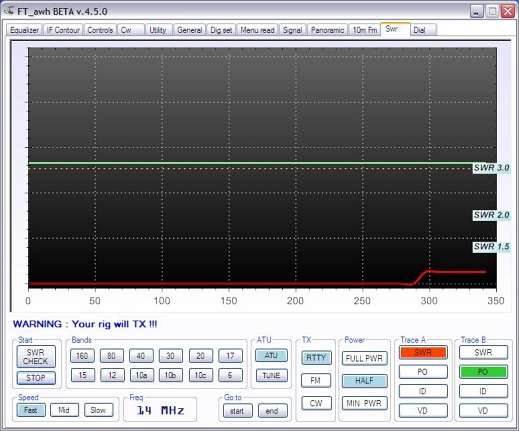
AWH Master Commander is control software for the Yaesu FT-2000 and the FT-950. What makes this suite of software different from Ham Radio Deluxe and other software for rig control is that each module shows a graphical representation of specific controls of each radio.

Here's an example of the connect screen for the FT-950.


This next control screen is the most impressive - a panoramic display in real time.


This next control component is the transmit equalizer and processor control screen.


Here's the 10 meter FM control module - with tone access control


And finally the SWR control and testing module - be careful of this one as it will sweep the entire band to map the SWR of your antenna. It will also check a band segment or single frequency.


This cutting edge software developed by Rick (Riccardo) Bertoli IW1AWH is in its current beta stage but I can tell you once you try it you'll be hooked. Awh Commander is turning out to be a very comprehensive piece of software to extend the controls of the FT-950 or the FT-2000 to your home computer or laptop. All that's needed is a serial cable connected from your laptop or shack computer to the FT-950 or the FT-2000.

I highly recommend the software and I'm looking forward to what Rick will be doing to further enhance Awh Commander. Rick gives SDR a whole new meaning with this fantastic piece of software.

You can download the beta version from Rick's blog here or go to the site of W4LGH in the U.S.

Tuesday, 4 November 2008

FT-950 Back On The Air


It's been a few months since I've fired up the FT-950. Got it dusted off and moved back to the shack. The last time it was used was at the MARG Field Day at the Long Island Marina in Kars. It's hard to forget how great the receiver is in the 950.

Late this afternoon I worked TK5IH in Corsica and ZP8AE in Paraguay, on PSK, with 589 and 599 reports using 20 watts to the Cushcraft R6000. Earlier in the day using the 'old' FT-100, I worked Maria, SA2YLM on 20 meters. 17 meters opened just after lunch for a short time and managed to snag a few Europeans with great 5NN reports.

The nice 'width' feature of the FT-950 allows me to narrow down the passband and get rid of high powered stations close to the DX that I want to work. The HRD* waterfall below shows the passband with many signals.


The HRD* waterfall below shows no signals, on either side of the received psk track. This eliminates desensing of the receiver by narrowing the passband so strong signals on either side of the track being decoded dissapear. The FT-950 can also notch out a signal on either side of the decoded signal.


I use Ham Radio Deluxe as control software and Digital Master 780 for digital modes. I find it is one of the most intuitive ham software suites. It keeps track of my logs and can be used for just about any digital mode now current on the amateur bands. There's an excellent satellite tracking module included. Simon Brown, HB9DRV, is continually adding features and tweaking the software. The Ham Radio Deluxe forums are a repository of information pertaining to any subject about digital modes and how to connect Yaesu, Icom, Kenwood, and just about any transceiver to sound card interfaces and to your shack computer. HRD works with Windows XP and Windows Vista.

Some PSK tips:
In PSK modes use UPPER CASE characters sparingly. Lower case text in PSK31 varicode transmits fewer bits of data. You'll increase transmit speed and improve the likelihood of proper decoding on the other end by using lower case text as much as possible. (For example, the difference between a lowercase “e” (11) and an uppercase “E” (1110111) is three times more bits.)

*Ham Radio Deluxe

Monday, 3 November 2008

The R6000 Rocks!

Finally got the antenna connected late this afternoon and got on 20 meters, PSK. Worked Florida and Cuba with about 15 watts to the antenna. 599+ reports so I could lower the power a bit more. I’m a bit hesitant to do this as I’m feeding it will el cheapo RG58 coax; about 110 feet of it so the attenuation is about 3.5db. Have to get some connectors on the good RG213 stuff that I have still coiled, new, in the basement.   spots2

Conditions seem to be very good as most signals are way over S9. There’s been some very recent sunspot activity. My favourite site for checking solar activity belongs to Kevin, VE3EN, down in Cornwall Ontario. There’s been a good bit of traffic in the forums these last few days. Check it out.

SOLARCYCLE24.COM

Technorati Tags: ,,

Friday, 5 September 2008

Setting your radio for weak signal work

At VE3MPG digital modes are the preferred operating mode. I use low power and stealth type antennas and have been using PSK modes since I acquired my FT-100 in 2000. I ran across a really great article written by Larry, W7IUV, where he explains how to set up a FT2000 (or the FT-950 or any rig for that matter) for weak signal work and I'll quote some of his superb information below:


One of the biggest problems I see is that most people either don't know how to set up a radio for weak signal or they do and refuse to do it due to some personal agenda. Here's the way to hear weak signals either SSB, or CW;

Listen to the background noise. Does it move the S-meter at all? If yes you have the radio set up wrong. Yaesu provided a switch to select preamps or not and another switch to select input attenuation. USE THEM! On the low bands (160-30 meters) I will almost never operate with one of the preamps on. IPO ON all the time. Look at the S-meter. If it wiggles at all with background noise, add attenuation until it stops wiggling. On all modern radios there is about a 20-30dB difference between MDS and where the AGC starts working. You want the background noise (QRN, power line, QRM, whatever) to be at a level just below the point where the AGC starts working. That's also the point where the S-meter starts wiggling! At this level, when you tune across a weak signal it will jump up out of the noise at you. Note that setting the radio this way will NOT impair your ability to hear the weakest signal possible with current band conditions. The S-meter does not tell you S/N, stop trying to make it read upscale all the time!

Use the narrowest filter possible. Wide for me is 300 Hz. That's what I use for trolling the band. When things get tuff, I switch down as far as possible. Learn to use the narrow filters, they work far far better than screwing around with the shift and notch and other do-dads.

Do not use the RF gain control. If you have a SX-100 or a HQ-180 or maybe a R-390A it's a good thing. With modern radios like the FT-2000, using the IPO and ATT is far more effective. Also, depending on how and where the AGC voltage is applied to the RF and IF stages, using the RF gain control could possibly reduce your IMD performance and reduce you ability to hear weak signals due to increasing the noise figure faster than reducing the gain.
I've tried Larry's methods and on my 'old' FT100 it works great. On the FT-950 it works even better. I can copy weak psk signals better and it gets rid of much of the background noise. The signal traces on digital modes become very distinct using this method.

More info on Larry:

Larry - W7IUV
http://w7iuv.com/