June and July were busy. Two trips to California and I’ve only been back less than a week from the last one. I had a few days of work and took a few days to just take it easy and see some of the coastline of California. One afternoon was spent on the Pacific Coast Highway north of Los Angeles. Then it was off to San Diego, a beautiful coastal city on the border of southern California and Mexico.
San Diego is home to the Pacific Fleet and there was no shortage of things to see in the harbour. Below is the USS Nimitz, a nuclear powered aircraft carrier anchored at the San Diego Naval Base. The USS Carl Vinson was anchored alongside.
 The ships were surrounded by floating buoys shaped like fat cigars – used to keep any boats away from the carriers – a precaution for all navy ships ever since the USS Cole was targeted and severely damaged in Yemen a few years ago. US Navy armed patrol ships continuously ply the waters near the naval ships guarding against intrusions.
The decommissioned USS Midway, named after the Battle of Midway, is anchored as a permanent museum in the harbour. She was launched in March of 1945 and she served in Korea, Vietnam and Operation Desert Storm. The Navy launched 228 sorties from Midway and Ranger (CV-61) in the Persian Gulf, from Theodore Roosevelt (CVN-71) en route to the Gulf, and from John F. Kennedy, Saratoga, and America in the Red Sea. Her flight deck is 4 acres in size.
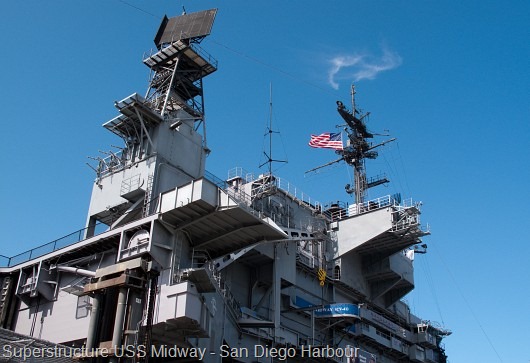

 The USS Midway is one large ship. It actually functioned as a small city so it had its own postal code. Naval engineering practices 60 years ago were quite advanced and subsequent refits over the years made it quite a modern carrier. Newer carriers have a 50 year life expectancy. The United States has 11 active aircraft carriers.


 Radio Comms center above (no ham shack here!). The main items that are visible are the three AN/USQ-69 data terminal sets with keyboard and CRT display, and an AN/UYK-20 computer.
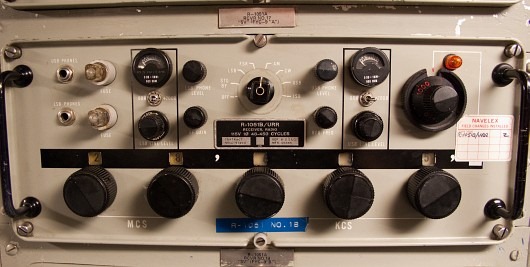
 Racks of R-1051B HF receivers in Comms Center
 This is the Command Center where the Commander and Officers watched Desert Storm play out on automated monitors – this was the ship’s nerve center.
 These are the outboard HF antennas in their horizontal positions on tiltable bases. There’s a set port and starboard.


Midway prepares to moor at her final resting place at Navy pier in San Diego where she was to become the largest museum devoted to carriers and naval aviation. (10 January 2004).
I also boarded a “Foxtrot” class Soviet submarine, B39, commissioned in the early 1970s. It was based on German WWII era U-boats. It had a crew of 78, was 300 feet in length and displaced 2000 tons. B39 was assigned to the Soviet Pacific fleet. I’m not sure how 78 sailors lived inside this sub for long period of time. I had a difficult time manoeuvring inside each compartment. Each compartment was accessible via a round porthole about 38 inches wide – you went in feet first and propelled yourself through it. The confined space was claustrophobic. They were extremely low tech but lethal and carried 24 torpedoes and some capable of low-yield nuclear warheads. They played a large part in the Cuban missile crisis and other cold war scenarios.
 B39 was Diesel-Electric – this design was even quieter than nuclear powered subs. They were used to track NATO and U.S. warship throughout the world’s oceans. See some interior shots here > B-39 Foxtrot-Class Diesel Submarine
So it was a great summer trip to California again. It’s an extremely beautiful state and the people of California are great. I’m headed out next month for a final visit this year.
 To those of you wondering what kind of camera I use it’s a Canon Powershot G10. I have a future article in the works on how I take and process my digital photos.
The Midway Museum


_decommissioned%5B12%5D.jpg "USS_Midway_(CV-41)_decommissioned")


