Showing posts with label PAR EndFedz. Show all posts

Tuesday, 17 August 2010

The Latest From PAR Electronics – Dale W4OP

PAR_logo_animated One of my most popular postings is the interview I did with Dale Parfitt, the owner of PAR Electronics, 2 years ago. Dale makes amateur and commercial antennas. The amateur line and specifically the PAR EndFedz antennas are big sellers, used by amateurs, SWLs, and commercial interests alike. If one checks the eHam ratings on the PAR antennas, well, they can’t get any better than a 5 across the board.

Over the years Dale has had trouble filling amateur orders and has had to rely on time slots of one to two weeks where amateur orders were taken and then filled. These windows of opportunity happened several times a year as PAR was just too busy with commercial interests to accommodate the amateur market full time. That is about to change.

On August 2, 2010 on the PAR Electronics website a press release was published indicating “LNR Precision acquires EndFedz line of amateur and SWL antennas”.

PAR EndFedz are now being manufactured exclusively by LNR Precision. Please contact them for pricing/availability.

On August 2, 2010 LNR Precision, Inc. acquired the popular EndFedz line of amateur and SWL antennas. Larry, AE4LD, is the new owner. Larry is a talented machinist, active amateur, QRPer and will be far better equipped to manufacture and expand the EndFedz line of antennas. In recent years, PAR has had to resort to only accepting orders in 1 week windows in order to better balance their growing commercial segment and the amateur products. LNR Precision will have much larger manufacturing capabilities and thus amateurs will benefit from much faster order filling. Dale W4OP will be staying on to complete new designs and offering technical assistance to LNR Precision. Amateurs can expect new novel EndFedz models in the near future.

I wish to thank the many thousands of amateurs who have bought EndFedz and whom I think of as friends. I will continue to design/manufacture both commercial and amateur filters and expand our line of commercial and amateur VHF/UHF antenna products and hopefully some really interesting surface mount accessories for HF rigs. You may contact Larry at controlliner@embarqmail.com.

Give us a few days to complete the transition.

I had also read about the change at PAR on several other websites like eHam and one of the Yahoo amateur groups.

I was surprised but glad that Dale had taken some steps to alleviate the EndFedz supply problem. I was sceptical about the level of service LNR Precision might be able to provide as Dale was always there to answer questions; even late into the evening. I don’t think we have to worry. I contacted Dale a few days ago and he graciously agreed to another interview. Here it is in its entirety:

VE3MPG: You've obviously made some difficult decisions in the last few months to sell off your amateur antenna division. Tell us how and why this came about and also finding a competent and astute business person, Larry  AE4LD, to carry on what you started.

Dale W4OP: This was a very hard decision to make. I felt as though I was caught between the proverbial rock and hard place. Our core business has always been commercial. Those clients are  very valuable to us but they can also be very demanding. As the EndFedz line continued to grow, I had to resort to limiting orders to 1 week windows every 5 weeks or so. This allowed us to better compartmentalize amateur production and time requirements but was not really fair to our clients. I was personally involved 80+ hours per week. This obviously was very tiring and also prevented me from pursuing other interests. So, I began looking for a buyer for the EndFedz. After four false starts, Larry came into the picture. He is the perfect candidate. He was already using our product. Larry also has injection molding capabilities and an extensive machine shop. Finally, he lives in North Carolina which made the entire transition much easier and smoother.

You mention some new antenna designs in your press release on your website. Can you give us an exclusive look into what's developing?

Dale W4OP: I really cannot divulge what I am currently working on- but it involves several new designs that I simply could not bring to market through  PAR for lack of production time. A couple are antennas that customers have long been asking for though. Look for some very novel antenna designs with pending patent claims.

With the acquisition of the manufacturing of the PAR amateur antennas including shipping and technical support, what will you do with your spare time? Any plans for a real holiday?

Dale W4OP: I love to play billiards and also I am a competitive distance runner. I will finally have the time to practice both sports and travel to meets. I also just bought another SGC SG-2020 and will be doing a lot of portable ops here in the mountains.

I live on a large Lake (Glenville) that has excellent lake trout, bass and walleye fishing. I have not even bought a license in the last three years. That also will change (my new fly reel just arrived today).

Amateurs around the world are using your antennas and have nothing but praise for the performance and build quality. Your almost immediate email support is legendary. I'm sure that my readers and the users of your fine products  will miss your rapport and camaraderie. What can you say about the loyal following your product and your service have created?

Dale W4OP: I have really been blessed by our clients; made many friends and really appreciate how loyal you all have been. This loyal, patient following is what made all the long hours worthwhile.

PAR will still be manufacturing our Omniangles, Stressed Moxons and filters for amateurs and scanning enthusiasts. I plan on staying active on the QRP reflectors and attending Dayton and FDIM.

In addition I will continue support for PAR products that are out in  the field and will be answering tech questions for LnR for at least a year.

It's been a great run and it's a wonderful feeling knowing the EndFedz line will continue on with Larry and the enthusiasm that he brings to the plate.

Can you add anything else?

Dale W4OP: I appreciate your site Bob. It is not everyone that can  put together insightful questions and keep all of this going. I know I speak for other followers of your site and blog in thanking you for putting your journalism skills to such an interesting and creative  use. Much success in the future. Now is Tokyo ever going to release that 160-->6M HT-200?HT-200

Thanks Dale for your generous contribution to my blog and to my readers. We wish you and Larry, AE4LD, at LnR Precision the very best in your new directions and endeavours.

My previous interview with Dale, W4OP, can be found at this link:

First interview with Dale Parfitt, October 2, 2008

PAR Electronics

LnR Precision

Sunday, 21 February 2010

Yaesu FT-950 – Solid Performer With PAR End Fedz

%5BUNSET%5D[1]

After over two years of owning the FT-950 it’s still a solid performer. In the field, during Field Day 2008 with auxiliary power and a PAR EF-40 End Fed along with a Buddipole it was exemplary. At home in the shack it’s even more fun. The menu system offers lots of settings for personal preferences and I often change parameters if I see something on the Yahoo FT-950 group that I find interesting. I keep copious notes in a small notebook of all the settings I’ve ever tried, with dates and comments. The primary use of the 950 is on psk and cw modes; I rarely run more than 30 watts to my antennas which include the Cushcraft R6000, and several PAR End Fedz dipoles. The PAR antennas have survived two brutal winters with ice storms. The last ice storm a few weeks ago saw the PAR antennas coated with almost 2 centimeters of ice but they held up very well. The EF-40 is over 20meters (66 feet) in length so that’s a lot of ice load to carry. We also get terrific winds out here but the PARs just keep going – a testament to their engineering and design. I have plans to erect a full G5RV and an end fed loop this year on my 2 acre property south of Ottawa. I would like to get back on 160 meters in time for next winter.

Since the release of the FT-950 in the fall of 2007 Yaesu in Japan has released firmware updates – numerous updates called the PEP950-Performance Enhancement Program with updates available for download on the Yaesu website. Each update added features and improved functions – with feedback garnered from the user community and Yaesu’s monitoring of the FT-950 group on Yahoo. Dennis Motschenbacher K7BV, (Yaesu VP of Sales) often drops by the group with information and comments. Dennis was even kind enough to send me a poster of the new Yaesu 5000 transceiver including the Yaesu world map. It’s really great to see a company interacting with users and potential users in this way.

In 2010 it’s hoped that Yaesu will continue to improve and update the firmware in the FT-950. With the release of the new FT-5000 Yaesu will continue to be at the forefront of cutting edge communications gear.

Cover_K9YA Telegraph MAY 2009 Some of you may be aware of free amateur radio publications such as WorldRadio online magazine available for download. There’s another publication free of charge from the Robert F. Heytow Memorial Radio Club called the KY9A Telegraph. It’s by subscription so an email notification is generated and sent to you when a new issue is ready for donwload. Both of these publications are in the Adobe PDF format. Highly recommended reading during these long winter nights.


Interview with Dale Parfitt – PAR Electronics

Tuesday, 24 March 2009

Antennas Survive Ottawa Winter

My antenna farm survived the brutal, windy, snowy, freezing rain type weather known in this neck of the woods. Some good planning, engineering and blind luck allowed my PAR EndFedz and my Cushcraft R6000 to survive unscathed through the arctic like conditions up here. A 3-point guy system protected my R6000 from self-destruction. The PAR EndFedz were securely anchored with enough slack to survive the windy conditions south of Ottawa. We do get some extreme winds out here. A couple of years ago, during a micro-burst type summer storm I lost some siding on the upper story of my home. Anything not anchored down gets blown to the next county.
DX has been hit and miss but throughout the season there's been some good conditions favourable for long haul communications. D44TXF on Cape Verde - 17m, NH6I Hawaii on 40 meters, ES3RM - Estonia on 17m, 5D0IPY - Morrocco on 17m, ZS6GAV - South Africa on 17m, and many more. The 17 meter band has been open during the very early morning hours during dawn and stays open for at least a couple of hours. Despite the low sunspot numbers there's a lot of DX to be had. I'm working these stations with a multi-band vertical and low power and on digital modes. Power reaching my R6000 vertical can't be more than 10-15 watts. I'm feeding it with 100 feet of RG59 75 ohm coax. At the transmit end I have my FT-950 set for 20 watts output.

The new Yaesu PEP FT-950 enhancements have made the FT-950 a superb DX rig. The receiver is quieter, the noise reduction settings now work great, and the AGC and Contour functions have been improved 100%. Check out the eham.net ratings for the FT-950 with the PEP enhancements. Satisfaction all around, and Yaesu is continuing to enhance the FT-9000, FT-2000 and FT-950 family of transceivers with regular firmware and DSP updates and features. The latest update to the FT-950 required a new operating manual to be released by Yaesu, such were the number of changes to the radio.

In conclusion the PAR EndFedz 40 and 30 meter antennas survived quite nicely through the rigours of an Ottawa winter, as did the recently refurbished Cushcraft R6000. Proper installation and guying were the key points that kept everything running with zero maintenance.

Wednesday, 4 February 2009

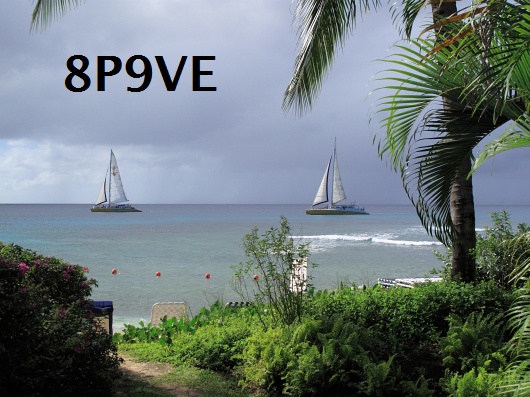
8P9VE Barbados Expedition


Ahhhhhh, warm, sunny, clear blue waters outside the door of a rented villa. Monday January 26th saw me leaving Ottawa (-29C) for a short holiday in beautiful friendly Barbados (28C). Ron, 8P6JB did all the paperwork and running around getting my license to operate in Barbados. I settled on the call 8P9VE as this represented a little of Canada in it.

The villa was at Reeds House on the north west shore of Barbados. The back entrance and patio of the villa descended to a white sand beach and palm trees. Very much a heaven compared to icy frozen Canada. I traveled with my VX-170 and VX-3R handhelds and a small external window mounted antenna. I just happened to be in the shadow of the island repeaters so I couldn't qso with anyone from the villa unless I was in the rented van and up at a high point away from shore.

The Barbados Amateur Radio Society meets at their club station every Friday night for a social get together, and Ron 8P6JB invited me to attend. The club station is located at one of the highest points of land on the island just outside Bridgetown. It sits on a former sugar plantation and you can see the remnants of the old wind mill that powered the plantation machinery.


The Friday meetings are very informal and softdrinks and beer are available to all - which probably makes these meeting very popular. I got to operate the club station which is equipped with very modern up to date gear.

Peter, 8P9NX, a retired M.D. from the Mayo clinic in Minnesota was operating the station when I arrived. He quickly set up the club laptop for psk and I made a few stateside contacts on 40m psk that evening.

Peter's obsession is golf and ham radio since he retired to the island a few years ago. He plans to sail his 37 foot sailboat with his son, from the U.S. to Barbados later this year. Peter works about 50 stations a day on his K3 and CW - he does a bit of psk too.
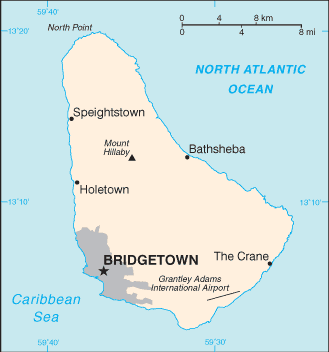
Barbados currently has about 150 licensed ham radio operators. Barbados' population is 281,968 (July 2008 Est.). Peter was telling me that at these latitudes 80 meters and 160 meters are great in the evenings with very low noise levels. Getting a license to operate in Barbados cost $15USD and you have to send a copy of your Canadian license and a list of all the equipment you'll be bringing to the island. The license is good for one year and I plan to go back in a few months with my own equipment and a couple of my PAR EndFed antennas packed away in my suitcase. Using the 8P9 call created quite a stir on 40 meters but qrm was high due to the number of stations.


The club station also has emergency backup power via batteries and generators in case of natural or man made disasters. The stations included a Yaesu FT-1000 MkV, an FT-450, 2 meter handhelds and base radios along with older Kenwood and Icom radios - so a very well designed and equipped ham station. Antennas include wire dipoles, various beams and verticals.

I would like to thank again Ron Wilkinson 8P6JB for all of the legwork and keeping in contact with me while on Barbados and the great Friday evening club meeting of January 30, 2009. And a big thanks to Peter 8P9NX for showing me the ropes at the club station.

Geography
Area: 431 sq. km. (166 sq. mi.); 2.5 times the size of Washington, DC.
Cities: Capital--Bridgetown.
Terrain: Generally flat, hilly in the interior.
Climate: Tropical.


Monday, 20 October 2008

PAR 30M End Fed Dipole - First DX


20081002-IMG_1750

ft-100These little gems, the PAR EndFedz, continue to amaze me. With 25 watts out on 30 meters, an FT-100 and Ham Radio Deluxe software I was able to work, GI4SIZ in Ireland 599, 9A0COAST on the island of Brac off the Dalmatian coast of Croatia with a 599, EA8KV, 599, in the Canary Islands and EB5DZC on the east coast of Spain 599. They were all perfect copy though with some qsb late this afternoon (20:00Z). The old FT-100 has a great receiver so I keep the RF gain cranked slightly to reduce band noise. I'm located about 20Kms south of Ottawa on a quiet country road so signals really pop out of the noise floor. Most evenings at this time of year the noise sits at S0. Even at this solar minimum some really good DX can be worked with efficient antennas. These little antennas work extremely well - highly recommended for portable or permanent installations.

Sunday, 19 October 2008

PAR End Fedz Antennas = Great DX

20081002-IMG_1747

The PAR EndFedz have been great performers at VE3MPG. My first use was at the Manotick Amateur Radio Group’s Field Day in June. I used the EF-40 meter version of the PAR with outstanding results. We threw it up in a tree, tacked the bottom feed point to a stake and 20080807-IMG_1318the SWR measured flat across the band. We constantly got reports on 40 that "you're the loudest signal on the band here!" In fact this were the comments we got from many of the stations we worked - they included signal reports included with the exchange to let us know how strong we were. My psk station, an FT-950 ran 35 watts all weekend powered by a Honda 2000i generator.

Have just installed my EF-30 PAR EndFed and it tunes up great first time up. The far end is up a white ash tree - 25 feet up and then the feed end is tethered to my support mast.

Make sure that you know your test equipment prior to installing any antenna. My MFJ antenna analyzer was causing all sorts of problems - I was blaming it on the PAR antenna until I ran into the same problem with the 30 meter end fed. Turns out the MFJ-259 had a half dozen cold solder joints and loose ground screws.

par_closeup_detail

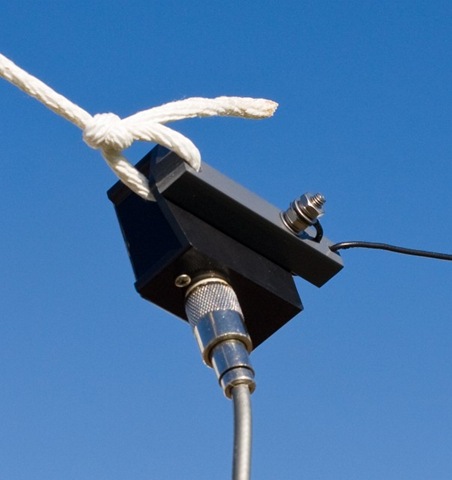
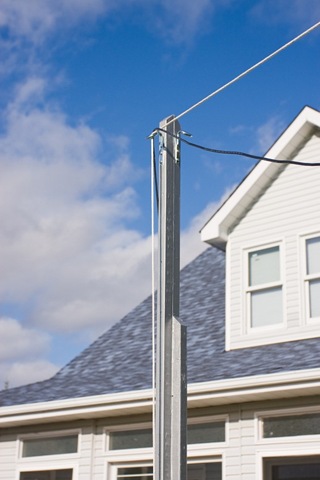
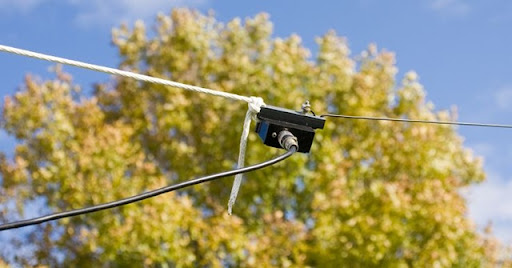
T20081002-IMG_1759he various pictures here show details on my masting - it was constructed from 1" x 1" pressure treated scrap lumber that sat unused in my woodshed for years, glued with exterior grade glue, then screwed together with galvanized screws. Notice that the upper sections are cut at 45 degrees so water or snow doesn't accumulate. Two coats of porch paint then spray painted with Rustoleum silver paint. All the screw countersinks and seams were filled with good quality caulking prior to painting. The mast assembly was then permanently affixed to a large wooden planter. Closed eyehooks complete the mast assembly to support coax and rope attached to the PAR match box. This method takes the weight off the matchbox and prevents the wire from sagging too much.

Tonight I get to try out the 30 meter PAR end fed - stay tuned.

20081002-IMG_1755

Thursday, 2 October 2008

Interview with Dale Parfitt, PAR Electronics

DaleParfitt_w4op.967603067 I conducted an email interview this afternoon with Dale Parfitt of PAR Electronics, the maker of the wondrous PAR EndFedz end fed dipoles. Dale's company also manufactures filters, mostly for the commercial market and military.

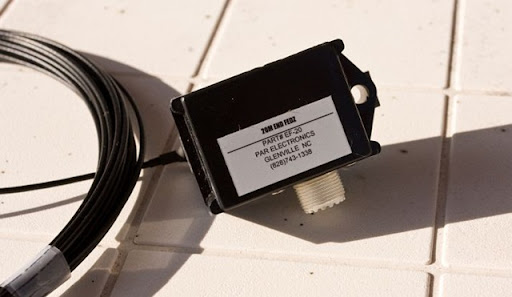
I own three of the PAR EndFedz, the EF-20, EF-30 and the EF-40 versions. In my next post I’ll show how easy these are to install and the post will include photos and close-ups of the antennas.

Here’s the interview.

Dale, how did you get started?

I received a BSEE from Syracuse U in '71 and an MSEE in 73. After a short stint with Sperry Flight Systems in Phoenix AZ, I went to work for Avanti R&D in their antenna lab. One of my patents is for the original On-Glass antenna. It came out of a need for me to operate 2M from my Corvette. The patent describes an end fed half wave antenna where the radiator and matching means are separated by a dielectric (glass in this case). That patent is now owned by The Allen Group. It was a strong patent, and imitators were forced to use inferior concepts that gave the ON-Glass antennas a poor reputation. It is unfortunate, because our original design (still marketed by Antenna Specialists) is NOT a compromise antenna and delivers superior performance. This basic design forms the basis for the EndFedz series. I enjoy hiking (actually running) the mountains of NC. I often take a rig with me and operate on stops. I needed an easy to deploy antenna.

Tell me a bit about your amateur radio background.

I became interested in amateur radio when I was 11 or so. Adult Ed in Elmira NY offered ham classes taught by W2HQY (SK) and W2ZBD (SK). The rub was that you had to be 18 years old to attend. So, my Mom who was at that time completing here BS in Nursing from Syracuse signed up and "baby sat" me. This was in 1963 or so. I was assigned a novice call WV2YPY. Back then, the novice was good for 1 year and non-renewable sink or swim. I loved CW and so the upgrade to WA2YPY came easily 6 months later. I was very active on HF DX and later VHF weak signal. During my college years I was totally inactive outside of an occasional stint at the SU club station.

Many years later my passion to VHF/UHF returned and I still operate a KW on 80-->6M [PRO III + SPE Expert solid state amp]. But my first love is 1296MHz EME where I am a medium sized station with a 14' dish and 400W homebrew solid state at the dish.

What is the market for the PAR antennas, and filters?

Our core business remains commercial. PAR filters are everywhere from flying in space to airports to FM broadcast stations to NASA's lightning detection system: http://www.nasa.gov/missions/science/lightning_warn.html

The market appears bottomless. Design is done with Eagleware's Genesys software - makes me look smart. Over the years I have become a decent machinist and have added digital capabilities to our mills and lathe.

Our Omniangle antennas virtually own the RFID industry because of their near-perfect omni pattern and zero feedline radiation. The EndFedz are used by our military and amateurs around the world.

How are your antennas used worldwide?

I have no clue as to how the military uses them - I don't even ask. The vast majority of EndFedz are in amateur use.

We do have piles of filters in Asia minor used in a system that measures snow pack data and transmits the collected via random meteor scatter. The filter criteria are very stringent and obviously, the filters must endure a very harsh environment.

Other filters are in use by militaries around the world for spectrum shaping.

Many years back, the FCC contacted us to design a version of our patented 2M IM filter to relieve the problem of pagers interfering with commercial boats on the Mississippi. Today, there may not be a commercial boat on that river that does not have a pair of our filters on board.

Where is PAR Electronics headed?

Hard to say. I have a lot of other interests that have been put on hold while PAR demands 80+ hour weeks. A number of very novel antennas have never seen the light of production simply because we cannot handle the order levels they would create. At some point, I'll turn the reigns over to a younger fellow.

How many people does PAR Electronics employ?

Very few. I am a perfectionist who does not play well with others. So, while I do bring people in to do some of the mundane milling and lathe work, 90% of the work is done by me from 9AM to 2AM 6 days/week. I am the ultimate micromanager (not a good thing) and instead of critiquing others' work- I just do it myself.

Are you surprised by the success of your company?

Most of the time, I don't see the forest for the trees. But when I look at the bottom line- yes, it is surprising. I believe a very large part of our success is treating our clients like family. We regularly stay late to make sure someone has a certain product for vacation etc. Anyone can do this if they are willing to go the extra mile for their clients. This is getting harder and harder as our commercial segment takes up more and more of the time we traditionally devoted to amateur radio - but we remain committed to the amateur segment.

Any other interesting facts about PAR or yourself.

My shop, in addition to the lab and machine shop has a beautiful Olhausen billiards table for stress relief. I have very little interest in modern gear (aside what is needed for EME) and a passion for restoration of the tube gear of days gone by. I love to build and make the end product look as though it came off a production line:
Dale's Receiver Pg150_small DDS HF general coverage RX.

My version of a solid state Drake 2B with added bells and whistles.
Dale's Drake2B_homebrew_small

So there you have it. A great interview with Dale Parfitt creator of the PAR EndFedz series of end fed dipoles.

http://www.parelectronics.com/

And some reviews of the PAR EndFedz on Eham.