Friday, 28 November 2008

Unconventional Antennas from NASA Labs

Yes, I know I'm writing a lot about NASA, the Jet Propulsion Labs, and space stuff in general. This interests me a lot, anything to do with space travel and its related technology. I still remember watching the historic moon land in 1969 on our first Zenith colour TV. You've probably noticed too that I like working with different antenna technologies.

I ran across a NASA article that describes their antenna design software. It's nothing like what's available to the ham community. Their software takes ten hours to design new antennas for their satellites and spacecraft. You can imagine the criteria as to size, weight, and performance required for operation in deep space.

Here's what their computer clusters have managed to design - very unconventional - it looks like a bent paper clip but their computers have determined this is the best performing hardware for their satellites.


NASA describes their software, that runs on a network of personal computers as "evolutionary". The above photo shows an antenna that can fit into a one-inch space (2.5 by 2.5 centimeters) in front of 'borg' of computers.

"The AI software examined millions of potential antenna designs before settling on a final one," said project lead Jason Lohn, a scientist at NASA's Ames Research Center, located in California's Silicon Valley. "Through a process patterned after Darwin's 'survival of the fittest,' the strongest designs survive and the less capable do not."

The software started with random antenna designs and through the evolutionary process, refined them. The computer system took about 10 hours to complete the initial antenna design process. "We told the computer program what performance the antenna should have, and the computer simulated evolution, keeping the best antenna designs that approached what we asked for. Eventually, it zeroed in on something that met the desired specifications for the mission," Lohn said.

When I visited the JPL in Pasadena California in April of this year I discovered a group of hams working there and they had a JPL ham club and repeater. Bets that some hams had a hand in this software. Now if they could only release the software to us lowly hams who use wire antennas and minimalist stealth antennas. I need something this small on 160 meters.

NASA 'EVOLUTIONARY' SOFTWARE AUTOMATICALLY DESIGNS ANTENNA

JPL Amateur Radio Club

(Photos courtesy of NASA Ames)

Monday, 24 November 2008

NASA Tests First Deep-Space Internet

NASA Jet Propulsion Laboratory (11/18/08)


Some exciting new communication technologies are sure to emerge from these new protocols - they may even trickle down to amateur digital modes.


NASA Jet Propulsion Laboratory (JPL) engineers have successfully tested the first deep space communications network based on the Internet, using the Disruption-Tolerant Networking (DTN) protocol to transmit dozens of images to and from a spacecraft more than 20 million miles from Earth. NASA and Google's Vint Cerf jointly developed the DTN protocol, which replaces the Internet's TCP/IP protocol for managing data transmissions. "This is the first step in creating a totally new space communications capability, an interplanetary Internet," says NASA's Adrian Hooke. An interplanetary Internet needs to be strong enough to withstand delays, disruptions, and lost connections that space can cause. For example, errors can happen when a spacecraft slips behind a planet, or when solar storms or long communication delays occur. Even traveling at the speed of light, communications sent between Mars and Earth take between three-and-a-half minutes to 20 minutes. Unlike TCP/IP, DTN does not assume there will be a constant end-to-end connection. DTN is designed so that if a destination path cannot be found, the data packets are not discarded but are kept in a network node until it can safely communicate with another node. In October, engineers started a month-long series of demonstrations, with data being transmitted using NASA's Deep Space Network twice a week.


Researchers say the interplanetary Internet could allow for new types of complex space missions that involve multiple landed, mobile, and orbiting spacecraft, as well as ensure reliable communications for astronauts on the surface of the moon.

NASA Tests First Deep-Space Internet

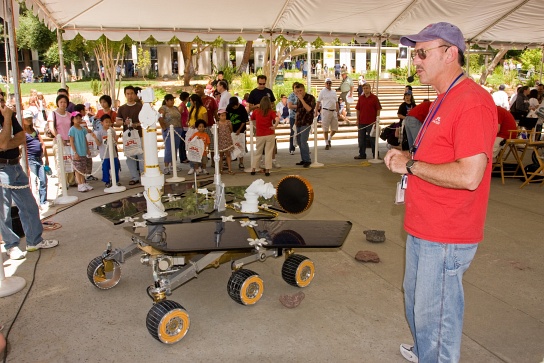
(photos were taken at the NASA JPL in Pasadena California, during my visit there in April 2008)

30 Meter Weekend

30 meters was very busy this weekend but I didn't get to operate very much due to a GTD (getting things done) list. The little time I did have to operate worked out quite well. I tried my hand at Olivia mode. I had just finished reading in the December08 QST about this magic mode and made a nice contact to W9NWR down in Wisconsin. Copy was excellent and it's expected of this mode. Though Chuck's signal was full copy with Digital Master 780 he wasn't moving the S meter. Olivia presented perfect copy with no effort on my part. I had the pre-amps off in the FT-950 and about -6dB of attenuation - just enough to lower the band noise. I like Olivia but it is a really slow mode of communications. I can see using it under extreme band conditions where noise is bad or the signals are not visible in the waterfall. At least I could keep the buffer full with my typing.

The next morning I snagged some good DX just before heading out for a Sunday filled with activities. ES0IC, Meeme, on the island of Kassari (IOTA-EU034) in Estonia on PSK31. He was 599 copy on my PAR EF-30 end fed dipole. A really nice contact and great DX to boot. I noticed many DX stations operating Sunday morning. Sunday night was good too and the band stayed open well past 10:30pm local time. A strong Puerto Rican station, WP3UX, was calling CQ for at least a couple of hours. On Saturday night the band closed just after sunset.

If you haven't tried 30 meters give it a go. It's a great DX band, only digital and CW modes are permitted (no contests!), and if you hit it right there's a lot of great DX to be had. All contacts on the weekend were completed using 20 watts output and using my FT-950. The 950 dsp filtering options are great for digital work.

To keep tabs on 30 meter DX activity I was using a new DX cluster called DXAnywhere programmed by a young British chap, Peter, M3PHP. Peter says, "The system also includes a full blown social networking system where users can setup profiles of themselves and their amateur radio background and become friends with other users! We're also keen on keeping the system fresh so on a monthly basis we're going to be adding new applications into the mix."

Friday, 21 November 2008

30 Meter Digital Group 1 Year Anniversary Weekend


For all of you digital mode enthusiasts this is the perfect weekend for testing those 30 meter antennas and setting the bandswitch to 30 meter position.

The 30 Meter Digital Group is celebrating their one year anniversary this weekend. The activity starts this weekend November 22nd and 23rd.

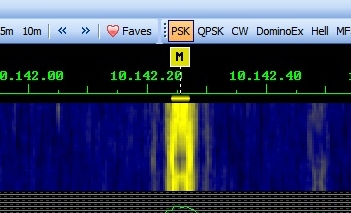
10.140 USB +/- 1000 PSK

(10.132 – 10.145 – HELL, OLIVIA, MFSK, RTTY, WSPR, PropNet, Etc)

10.140 +2000 – 30MDG Members Dedicated Hours from 1900z to 2200z - 30MDG members look for other members to ragchew with further up the waterfall.

Let's celebrate our 30MDG 1st year anniversary and have some fun on the 30 Meter Band! The 30 Meter Digital Group would like to invite our 1,350 plus members along with any and all digital operators for a casual digital weekend on the 30 Meter Band.

Those that are 30MDG members this would be a good time to mark your calendar and meet up with other 30MDG Members for a ragchew or meet a DX member. You do NOT have to be a 30MDG member nor join the 30MDG to participate; just get on the 30m band and have some digital fun!

Our 30 Meter Digital Group promotes:

- Awareness of the unique 30 Meter Band (note: we are SECONDARY USERS
of this band and must give way to Primary users so please use good operating procedures)

- Proper digital mode operation and procedures

- Experimenting with different digital modes, power, antennas, etc.

- Low power operation and only using the least amount of power needed for the contact at hand (note: 75% of digital mode operators use between 20-40w on the band…also note for U.S.A. operators the 30m band is a great place because we must use <200w so we are all on the same playing field on the 30 meter band…oh yes, no voice for U.S.A. ops so it is really an all digital band)

- Casual operating on the 30 Meter Band from ragchews to DX but we do NOT promote Contesting….30 Meters is a WARC band and one place we all can enjoy away from contesting.

- Increase 30 Meter digital mode use on this under used unique band that has the best of both 20 Meter and 40 Meter propagation because it sits between them (again note we are SECONDARY USERS)

Here at VE3MPG I use the PAR EF-30 End Fed Dipole on 30 meters. I'll report after the weekend on conditions and activities.

Yahoo 30 Meter PSK Group

30 Meter Digital Group

30 Meter Antennas

Arnie Coro CO2KK talks about 30 meters

Wednesday, 19 November 2008

VE3MPG, Cyborg and Bionic Ham

Cyborg is a fictional character, a superhero appearing in comic books published by DC Comics. Ooops wrong definition; here we go again - Cyborg: A cyborg is a cybernetic organism (i.e., an organism that has both artificial and natural systems). The term was coined in 1960 when Manfred Clynes and Nathan Kline used it in an article about the advantages of self-regulating human-machine systems in outer space. That's close enough, though I haven't been to outer space yet but it could happen. And, I'm not a superhero or even a superham.

In the fall of 2006 I received a cochlear implant, my bionic implant.

In the mid 1980s I was losing my hearing at a rapid pace due to a genetic fault. Many in my family were hard of hearing and the older family members, my father and my grandmother were left with little hearing. By 1990 I was wearing two intra canal digital aids but speech and going to the movies and TV were extremely difficult to hear. By 1993 I was profoundly deaf and could barely use a phone and had a closed captioning device on my TV set. I was wearing very powerful behind the ear aids at that time and by the year 2000 I was really struggling. I had my first appointment at the Audiology Unit at Ottawa's Civic Hospital but didn't qualify for an implant at that time. Apparently I wasn't deaf enough yet. Criteria has since changed making it much easier to qualify for a cochlear implant.

Deaf or hard of hearing persons learn to cope with their disability and I learned to lip read very well. Of course lip reading only worked if the other person was facing me. I carried on pretty well in this way for a few years. In 2005 while at home my burglar alarm tripped and two squad cars showed up - I live out in the country but it didn't take long for the police to respond. I signed to them that I was deaf and they wondered if I could hear the alarm and I shook my head 'no'. Well that was the turning point for me - I could no longer use a telephone but did rely on the very early Blackberries for text and email messaging - another way of coping.

So I got with the program again at the Civic hospital after an audiologist at the Canadian Hearing Society recommended it since hearing aids couldn't do anything more for me.

Curtail my ham activities it did. In 1993 I got so discouraged I sold my HF gear, a beautiful Kenwood TS-520SE as I couldn't hear SSB anymore. CW was fine even up to my last few days before the implant. With the little residual hearing I had left I was still able to hear that CW tone. I hadn't done 2 meters from the car for years but still had a radio installed just in case. I remember the day I just couldn't struggle anymore not hearing the guys on the repeater. I really missed that.


Pictured above is the implant receiver, the Advanced Bionics HiRes 90k the most advanced DSP based processor available. The gold plated titanium part is the enclosure for the electronics. The clear part with gold wires running along the perimeter is the implant antenna with a small magnet in the center. The long sensor array tip is wound inside the cochlea of the inner ear. There are 16 sensors on the tip and most of them end up touching ever so slightly some of the nerves inside the damaged cochlea. A small channel is routed out from the surface of the skull just above and behind the ear to seat the processor and antenna. A hole is then drilled through the mastoid bone behind the ear to carefully insert and position the sensor array in the cochlea. Some extremely small metal guide tools are used by the surgeon to carefully insert the array without doing any damage to the fragile cochlea.

This photo shows a channel routed from the skull - where the receiver will reside. You can see the sutures that will hold the receiver in place and the electrode lead channel. The skin and scalp are then replaced and sutured back. I arrived at the Civic Hospital in the morning and was prepped for surgery. After 5.5 hours in the OR I was wheeled into recovery, then ICU and was released at 6a.m. the next morning. Five weeks later my implant was activated.

Did deafness affect my ham radio hobby? Yes it did. Did I give up? No!

Helen Keller said that if she had to choose between being deaf and being blind, she'd be blind, because while blindness cut her off from things, deafness cut her off from people.

My hearing today is based on the skills of the engineers, programmers and researchers at Advanced Bionics in California. Sound is coded in bits and bytes and transformed into something recognizable to my brain. My implant has 16 electrodes, but the virtual-channels software will make my hardware act like there are actually 121. Manipulating the flow of electricity to target neurons between each electrode creates the illusion of seven new electrodes between each actual pair, similar to the way an audio engineer can make a sound appear to emanate from between two speakers. It takes at least 100 channels to create good music perception.

The photo above is me, five weeks after surgery and the day of my 'activation'. This is the external processor with a small T-mic in the ear where the sound is picked up. The gray headpiece is held on with a small magnet where the internal receiver, antenna and magnet are located. A battery located on the external processor powers the internal electronics through the skin. A diagnostic light on the external processor stops blinking when a data link is established with the internal processor. I'm being programmed via that cable to an XP computer running Advanced Bionics' mapping software. Three new strategies can be programmed to the external processor - I have one for loud environments, very quiet environments and one for regular sound environments. The T-mic detaches and I can plug my Ipod directly to my implant for listening to music (mono only!) or podcasts which I download to the Ipod Touch.

I am slowly making more voice contacts on SSB and FM but still have a lot of difficulty with bad audio on the phone bands. Some operators have excellent audio while many have overprocessed and overdriven audio. I find this especially on the local HF nets where good net etiquette is not followed. The net controls either speak too fast or you get the 'yellers' with their mic gain turned up too high. It will just take time and the patience of the hams at the other end of the mic. Today most of my HF activity centers on the digital modes and I enjoy that immensly.

If any of you have questions about this article please post them in the comments section or email me directly via the QRZ.com listing for my call.

Sunday, 16 November 2008

17 Meters and K4CMC

17 meters has been open for most of the morning to Europe and now the southern U.S. states are rolling in. QSB is heavy but signals are 20+ S9 most of the time. I worked Bruce Davis, K4CMC. He used to work at NASA during the Apollo moon missions. Small world after posting the article about the recovered moon photos yesterday.

Here's a picture of Bruce in the Apollo 11 cockpit at Kennedy Space Center in July of
1969 about one week prior to the first lunar landing mission.


Bruce says, "After getting out of the USAF I worked as an Instrumentation Technician and then as a Senior Apollo Spacecraft Electronic Technician at Kennedy Space Center from 1965-1970 as a Spacecraft Operator (SCO) in cockpit of Apollo Spacecraft during ground testing on many of the Apollo missions,including Apollo 11 and Apollo 13."

This is the coolness factor of amateur radio. You really never know who you are going to meet on the air. I always make it a habit to check QRZ.com for profiles of the hams I meet on the bands.

Saturday, 15 November 2008

New Pictures of the Moon Discovered

A woman saves the 1960s photo archives of the moon's surface


This article really is about ham radio - well more specifically how collecting and hoarding our treasures can really pay off. The absolutely cool technical stuff going on here is historical, especially with the 40th anniversary of the moon landing taking place next year on July 20th 2009.

A retired NASA employee, Nancy Evans, kept many things in her garage. But as time passed, NASA forgot. In fact, it would have thrown the machines out, if not for Nancy Evans, who had worked the project. She stored the machines in her garage for more than 20 years, and when NASA wanted to recycle the moon tapes, she took those, too.

"I had spent most of my working life saving data, and salvaging data, seeing that it got put safely in the planetary data system. I wasn't about to let this huge data set be thrown away," said Nancy Evans, a former NASA/JPL researcher.

In the late 1960s, NASA sent five Lunar Orbiter missions to photograph the surface of the moon and gain a better understanding of the lunar environment in advance of the Apollo program. Data were recorded on large magnetic tapes and transferred to photographic film for scientific analysis. When these images were first retrieved from lunar orbit, only a portion of their true resolution was available because of the limited technology available.

The Lunar Orbiter Image Recovery Project, located at NASA's Ames Research Center at Moffett Field, Calif., is taking analog data from original recorders used to store on tape and 1,500 of the original tapes, converting the data into digital form, and reconstructing the images. The restored image released Thursday confirms data from the original tapes can be retrieved from the newly-restored tape drives from the 1960s when combined with software from 2008.

"I'm glad that we could offer our services to the project team and play a part in the recovery of such an historic image of the moon," said Ames Director S. Pete Worden.

Future images will be made publicly available when they are fully processed and calibrated. The intent of this project is to facilitate, wherever possible, the broadest dissemination and public use of these images.

"It's a tremendous feeling to restore a 40-year-old image and know it can be useful to future explorers," said Gregory Schmidt, deputy director of the NASA Lunar Science Institute at Ames. "Now that we've demonstrated the capability to retrieve images, our goal is to complete the tape drives' restoration and move toward retrieving all of the images on the remaining tapes," he added.

Another, image of the lunar surface now shows details as small as one meter, which they can compare with future mapping missions.

"This is going to show us how the moon is changing. We fully expecting to see some new craters," said Greg Schmidt, Deputy Director of Lunar Sciences.

A classic case of pulling treasure from what might have been in the trash and all because Nancy Evans was a bit of a packrat.

As the images are processed, they will be submitted to the Planetary Data System, which NASA's Space Science Mission Directorate in Washington sponsors in cooperation with NASA's Jet Propulsion Laboratory in Pasadena, Calif. The images also will be calibrated with standard mapping coordinates from the U.S. Geological Survey's Astrogeology Research Program in Flagstaff, Ariz.

NASA will launch the Lunar Reconnaissance Orbiter in 2009 to map the moon's surface. The restoration of the Lunar Orbiter images to high quality images will provide the scientific community with a baseline to measure and understand changes that have occurred on the moon since the 1960s. These data could help mission planners assess the long-term risk to lunar inhabitants from small meteor impacts and establish longitude and latitude lines for lunar mapping.

"This effort was made possible by the vision and dedication of Apollo-era NASA employees, independent researchers, and a true veteran team of engineers and young students," said Dennis Wingo, the program lead for the project.

"We liken it to archeology. Techno-archeology," said Dennis Wingo, an imaging expert.

NASA's Exploration Systems Mission Directorate and Innovative Partnerships Program Office in Washington provided initial funding for the project. Engineering and logistics for the project team were provided by Wingo of SkyCorp, Inc., Huntsville, Ala., with donated services by Keith Cowing from SpaceRef Interactive, Inc., Reston, Va., under the auspices of Alliance of Commercial Enterprises and Education for Space, and the NASA Lunar Science Institute.

To view the image and for more information about the Lunar Orbiter Image Recovery Project, visit:

http://www.nasa.gov/topics/moonmars/features/LOIRP

and

http://www.moonviews.com

For more information about NASA's exploration program, visit:

http://www.nasa.gov/exploration

Download video about the LOIRP project.

Thanks to NASA Ames, JPL in Pasedena and ABC News (KG0-TV, San Fransisco)